
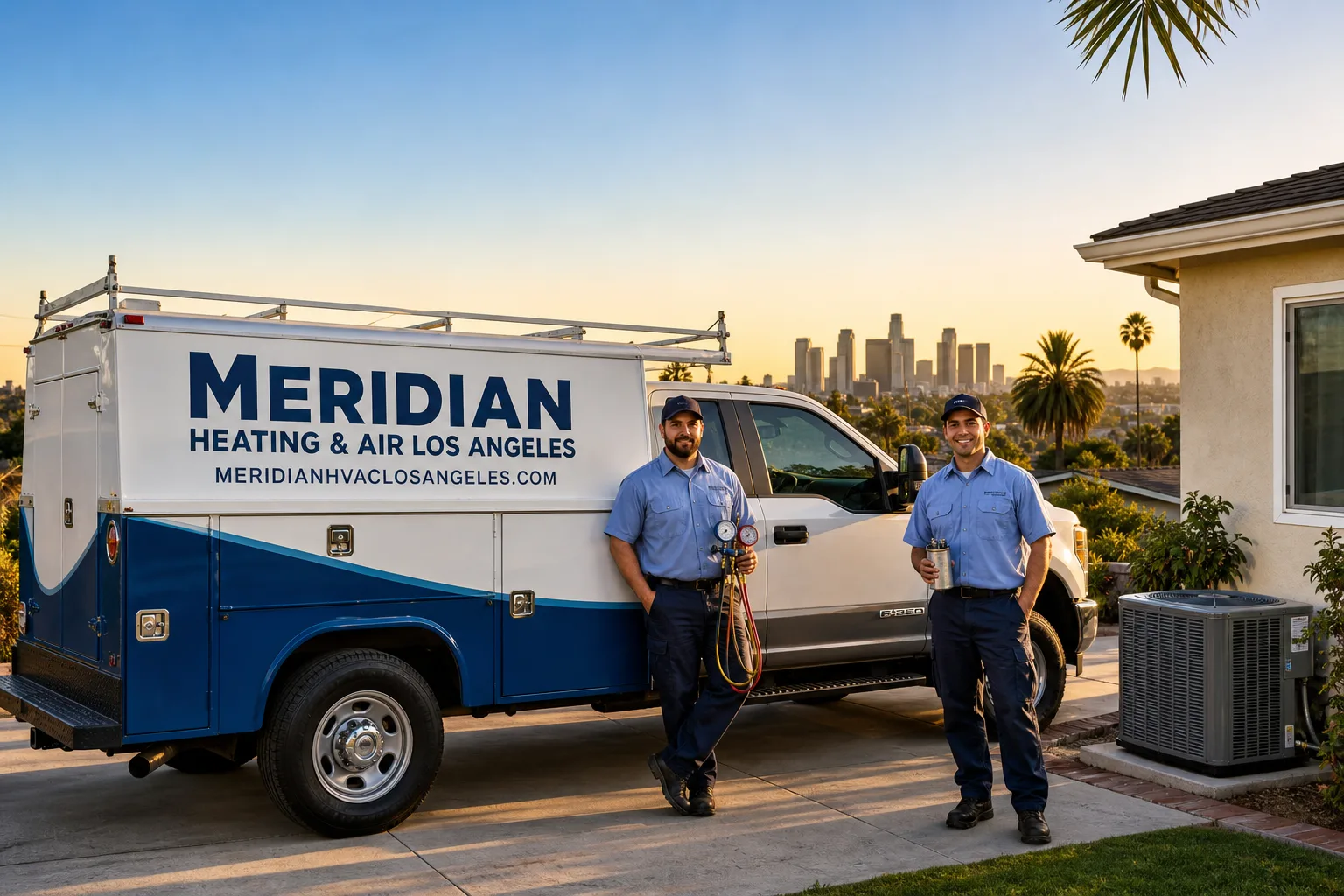
Fast, Reliable Emergency & Commercial HVAC Across North Hills
When your AC dies at 2 a.m. in a North Hills July, or your restaurant’s rooftop unit quits before the lunch rush, you need someone who knows this valley and shows up fast. We’re Meridian Heating & Air Los Angeles, and we answer emergency and commercial HVAC calls across North Hills, from the 1950s tract homes near Sepulveda Basin to the post-1994 rebuilds along Parthenia Street and the apartment clusters off Nordhoff. Anthony Moreno, our founder and lead installer, has spent nearly two decades in attics and on rooftops here. He knows that a North Hills summer isn’t a coastal summer — it’s 105°F, 110°F, sometimes higher, with equipment running flat out for months. That’s when systems fail. Call us at (877) 454-5066 for 24/7 emergency service or to schedule a commercial inspection.
Why Meridian Heating & Air Los Angeles Is North Hills’s Preferred Emergency & Commercial HVAC Company
We’ve built our reputation one call at a time across the San Fernando Valley, and North Hills accounts for a significant share of our 286 verified reviews averaging 4.8 out of 5 stars. Customers here mention the same things repeatedly: Anthony showed up himself, diagnosed the actual problem instead of pushing a full replacement, and fixed it that day.
Our response time to North Hills is fast because we’re based in Los Angeles and know the local streets — Parthenia, Nordhoff, Roscoe, the 405 to 118 transition — without GPS guesswork. We’ve worked on systems in the 91343 and 91393 ZIP codes long enough to recognize patterns: which 1995 rebuilds got quality installs, which got rushed post-disaster contractor jobs, where the 1950s slab homes have original ductwork crumbling in 160°F attics. That local knowledge saves diagnostic time and money.
Our Emergency & Commercial HVAC team handles everything from midnight residential no-cool calls to full rooftop unit replacements on commercial buildings. One company, consistent hands, no subcontractor roulette.
Our Emergency & Commercial HVAC Services in North Hills
24/7 Emergency HVAC
North Hills doesn’t cool off at night in August. When your blower motor seizes at 11 p.m. or your compressor locks up on a Saturday, we answer. Our emergency line — (877) 454-5066 — connects you directly to our dispatch, not a call center in another state. We carry capacitors, contactors, refrigerant, and common blower motors for the brands we see most in this area: Rheem, York, Daikin, Bryant, and others. Most emergency repairs in North Hills run $150–$650 depending on parts and refrigerant needs.

Commercial HVAC
North Hills’s commercial mix includes small retail along Sepulveda Boulevard, medical offices, light industrial near the railroad corridor, and multi-family housing with central plant systems. Each has different load profiles and occupancy demands. We design, install, and service commercial systems with Anthony Moreno leading the technical work — not handing it off to a crew you’ve never met. Commercial repairs typically fall in the $150–$700 range; full system installations vary widely based on tonnage and duct configuration.

Rooftop Unit (RTU) Service
Flat-roof commercial buildings in North Hills — especially the 1980s and 1990s structures along major corridors — rely on packaged rooftop units. These systems take direct sun all day, with roof surface temperatures exceeding 140°F in July. We service and replace RTUs from all major manufacturers, with particular experience on York and Daikin commercial lines. Annual maintenance runs $80–$200 per unit and typically catches the refrigerant leaks, economizer failures, and blower belt wear that shut systems down without warning.

Chiller Service
While less common in smaller North Hills commercial buildings, chillers serve several medical and light industrial facilities in the area. We handle chiller diagnostics, refrigerant management, and pump repairs. Given North Hills’s extreme heat load, chiller efficiency degrades faster here than in coastal zones; neglected systems can see 30% capacity loss before anyone notices.

What happens when you call
- 1
A real person answersNo phone trees — you reach a local pro.
- 2
You get an upfront price rangeHonest numbers before anyone is dispatched.
- 3
A background-checked tech heads outLicensed & insured, dispatched right away.
- 4
You approve before work beginsNothing starts until you say go.
Trusted Brands We Service in North Hills
We work on your brand — that’s not a slogan, it’s how we operate. Anthony Moreno is factory-trained or field-experienced on nine major HVAC manufacturers: Carrier, Trane, Lennox, Goodman, Rheem, York, Daikin, Bryant, and American Standard. For North Hills customers, this means we don’t try to shoehorn your system into a one-brand solution or claim your equipment is “too old to fix.” We stock common parts locally for Rheem, York, and Bryant systems, which represent a significant share of the post-1994 installs in this neighborhood. When we don’t have it on the truck, our supplier relationships in the San Fernando Valley mean next-day availability in most cases. Fast turnaround matters when it’s 108°F and your system is down.
Common Emergency & Commercial HVAC Problems We See in North Hills Homes
- Post-quake R-22 systems losing refrigerant from micro-cracked condenser coils. The 1994 Northridge earthquake shifted foundations and settled pads across North Hills. Systems installed in 1995–1997 often run on R-22 refrigerant, now phased out and expensive. Micro-cracks from seismic settling leak slowly, causing low-pressure trips and frozen coils. We pressure-test, locate leaks, and give honest repair-vs-replace guidance based on refrigerant cost and coil condition.
- Flex duct collapsing in superheated attics. Attic temperatures in North Hills tract homes regularly hit 150–160°F in July and August. Flex duct runs, especially in 1950s homes with original undersized returns, degrade and collapse under negative pressure faster than manufacturer ratings assume. We pull static pressure readings on every diagnostic call and almost always find R-4 or lower insulation that is essentially pre-heating supply air before it reaches your registers.
- Blower motor failure in slab-foundation homes with attic-mounted units. North Hills’s 1950s–1970s tract homes on slab foundations typically locate the air handler in the attic — zero shade, maximum heat. Bearing wear accelerates dramatically. We see blower motors failing at 8–10 years instead of the 15–20 you’d expect in milder climates. Replacement motors run $150–$650 installed depending on horsepower and OEM vs. aftermarket.
- Capacitor and contactor failure from continuous high-amp operation. When it’s 110°F for weeks straight, your compressor works harder, draws more amps, and cooks its start components. We replaced three dual-run capacitors on Parthenia Street alone during one August heat wave. It’s a $150–$350 repair if caught before compressor damage — much more if the hard start kills the compressor itself.
Pricing for Emergency & Commercial HVAC in North Hills, CA
We don’t quote over the phone without seeing your system, but we can tell you what North Hills customers typically pay. Our pricing reflects Los Angeles market rates with no surprise add-ons.
| Service | Typical Range in North Hills |
|---|---|
| AC Repair | $150–$650 |
| Furnace Repair | $150–$700 |
| AC Installation | $3,500–$7,500 |
| Tune-Up / Maintenance | $80–$200 |
What moves you within these ranges? Refrigerant type and quantity (R-22 is costly and scarce), accessibility (tight attic vs. ground-level package unit), and whether we find secondary damage like burnt wiring or failed capacitors. For the 1994–1997 post-quake equipment cohort now aging out across North Hills, replacement often makes more sense than pouring money into R-22 repairs on a 30-year-old system. We’ll show you the math. Estimates are free — call (877) 454-5066 to schedule.
North Hills’s Unique HVAC Challenge: The Post-Quake Equipment Cohort
Here’s something no generic HVAC page can tell you. North Hills sits within meters of the 1994 Northridge earthquake epicenter. The neighborhood, then called Sepulveda, suffered some of the worst structural damage in the region. That triggered a concentrated wave of rebuilding and new HVAC installation from 1994 to 1997. That equipment cohort is now 28–30 years old and aging out simultaneously.
This creates a replacement demand surge specific to this pocket of the Valley. Neighboring Northridge or Panorama City don’t have the same concentration of 1995–1997 systems hitting end-of-life together. We see it in our call volume: North Hills customers calling with compressor failures, cracked heat exchangers, and refrigerant leaks all traceable to systems installed by the same generation of post-disaster contractors. Some of those installs were quality work. Others were rushed. We’re honest about which is which when we inspect your system.
We responded to a Saturday night no-cool call in a 1995 post-quake rebuild on Parthenia Street. The contractor had installed a 3.5-ton 10-SEER Rheem in 1996; the compressor had locked up from years of 110°F attic heat degrading the run capacitor. We swapped in a 16-SEER Carrier with proper refrigerant charge and duct sealing, dropping their August electric bill by 28%. That’s the difference between a band-aid and a real fix.
We Also Serve Cities Near North Hills
Our service radius covers the full San Fernando Valley, including Northridge to the west, Van Nuys to the south, Valley Glen to the southeast, and San Fernando to the north. If you’re on the border between cities — say, near the North Hills-Northridge line along Devonshire — we’ll dispatch to your address, not debate ZIP code boundaries. Our Emergency & Commercial HVAC coverage extends across all these communities with the same owner-led service model.
Serving North Hills, CA — Our Local Coverage Area
We’re based in the North Hills area and know this community well. Use the map below to see our service coverage — if you’re nearby, we can almost certainly help.
FAQs — Emergency & Commercial HVAC in North Hills
North Hills records its highest sustained temperatures in late July and early August, with attic temperatures reaching 150–160°F and outdoor highs hitting 105–110°F. Equipment that was marginal in June fails under the accumulated thermal stress of six to eight weeks of near-continuous operation. Capacitors degrade, refrigerant pressures spike, and blower motors overheat. If your system is showing strain — unusual noise, weak airflow, or short cycling — call (877) 454-5066 before it quits entirely. A $150–$350 capacitor replacement beats a $3,500–$7,500 system replacement.
Replace it, in most cases. A 1997 system runs on R-22 refrigerant, which is no longer manufactured and costs $80–$150 per pound. The compressor, heat exchanger, and electrical components are all at end-of-life. We’ve done the math with dozens of North Hills homeowners: one major R-22 repair plus a subsequent failure typically exceeds half the cost of a new 16-SEER system. New installs in North Hills run $3,500–$7,500 depending on size and duct condition. We offer free replacement estimates — call to schedule.
Yes, proper sizing and specification matter more here than in coastal LA. A rooftop unit rated for “Los Angeles” conditions may be undersized for North Hills’s 25–30°F temperature premium. We specify equipment with higher ambient temperature ratings, proper economizer controls for morning cool-down, and sufficient redundancy for commercial applications. RTU replacement typically falls within commercial installation ranges; call (877) 454-5066 for a site-specific assessment.
Weak airflow in North Hills usually traces to one of three causes: collapsed flex duct in a superheated attic, an undersized or blocked return path, or a failing blower motor. In 1950s tract homes, we regularly find original ductwork with R-4 insulation that has degraded to the point of air leakage. In post-1994 rebuilds, flex duct can separate at connections after decades of thermal expansion and contraction. We measure static pressure and inspect accessible ductwork on every diagnostic call. Repairs run $150–$650; full duct replacement is quoted separately.
Yes, the neighborhood was renamed North Hills in 1999, five years after the 1994 earthquake. The old name still appears on some property records and original building permits, which can create confusion when tracing HVAC installation dates. If you’re trying to determine whether your system is original to a 1995–1997 rebuild, check the data plate on the outdoor unit — the manufacture date is more reliable than permit records, which sometimes carry the Sepulveda address. Anthony Moreno can read that data plate and tell you exactly what you’re dealing with.
Ready to get your North Hills home or business cooling properly again? Call (877) 454-5066 for 24/7 emergency service or to schedule your free estimate. Anthony Moreno answers calls personally when he’s not on a ladder, and he’ll show up on your job — not send a stranger.
Written by Anthony Moreno, Owner at Meridian Heating & Air Los Angeles, serving North Hills and the San Fernando Valley since 2005.