
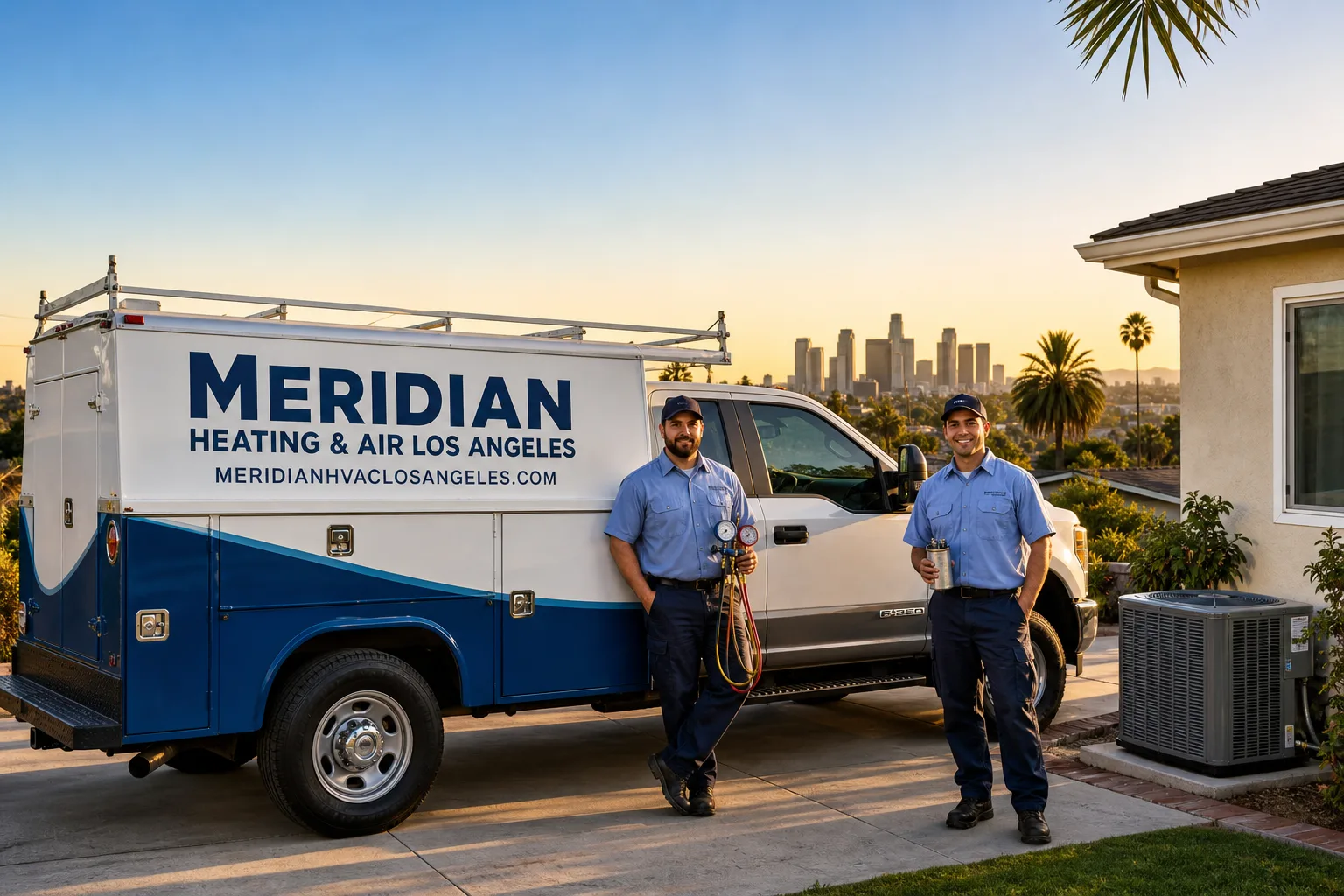
Fast, Reliable Heat Pump & Mini Split Across Apple Valley
Heat pump and mini split installation in Apple Valley typically runs $3,800–$8,500 for a full system, with repairs ranging $175–$765 depending on the issue. We’re usually on-site within the same day for calls from the 92307 and 92308 ZIP codes. You can reach Meridian Heating & Air Los Angeles at (877) 454-5066 for a free estimate.
We’ve been driving out to Apple Valley for nearly two decades now, and the jobs here are different from anything we see closer to Los Angeles. The acreage properties, the detached workshops, the 1960s ranch homes still running original swamp cooler ductwork — this isn’t a cookie-cutter market. Anthony Moreno, our founder and lead installer, personally handles the sizing and layout for these projects because getting it wrong means a second trip, and nobody out on Tussing Ranch Road or Bear Valley Road wants to wait around for that.
Why Meridian Heating & Air Los Angeles Is Apple Valley’s Preferred Heat Pump & Mini Split Company
Our reputation in Apple Valley was built one job at a time, mostly through word of mouth between neighbors on large lots who talk to each other. We’ve got 286 verified reviews averaging 4.8 out of 5 stars, and a solid chunk of those come from repeat customers in the Victor Valley who’ve had us back for second properties, workshop additions, or upgrades from evaporative coolers.
Response time matters when you’re dealing with 105°F summer days or hard-freeze winter nights that can lock up a heat pump’s refrigerant lines. We keep parts stocked for the brands Apple Valley homeowners actually have — Rheem, York, Daikin, Bryant — so we’re not ordering components from Ontario while your system sits dead. Anthony shows up on the job himself, not a rotating subcontractor who’s never seen a 3,000-square-foot garage workshop with 14-foot ceilings.
We know the local building stock cold: the original 1960s–1970s resort-retirement ranch homes with degraded duct insulation, the 2000s tract builds with attic cavities that hit 150°F+, and the custom acreage properties where standard load calculations don’t apply. That local knowledge saves our Apple Valley customers money and callbacks.
Our Heat Pump & Mini Split Services in Apple Valley
Heat Pump Repair
Apple Valley’s dual-demand climate — 105°F summers, mid-20s winter nights — beats hard on heat pump components. We see compressor contactors welded shut from constant cycling, refrigerant lines that’ve lost charge through vibration cracks on the long pipe runs common in acreage properties, and defrost boards failing after hard-freeze events that shorter-duty systems elsewhere in SoCal never face. Our Heat Pump & Mini Split team carries replacement boards, capacitors, and refrigerant for the nine brands we service, and Anthony diagnoses before quoting so you’re not paying for exploratory work.

Heat Pump Installation
New heat pump installs in Apple Valley need to be sized for genuine heating load, not the token capacity that works in coastal California. We calculate Manual J loads that account for your home’s actual envelope — dark roofing, attic ventilation, single-pane windows common in the older ranch stock — and we specify cold-climate heat pumps with enhanced defrost when the job demands it. For the 2000s tract homes with failing builder-grade systems, we’ve replaced dozens of straight-cool units with dual-fuel or all-electric heat pumps that handle both extremes without the homeowner thinking twice.

Mini Split Install
This is where Apple Valley gets interesting. The acreage lots — 1 to 5 acres is typical — mean detached workshops, RV barns, guest casitas, and server rooms that need dedicated climate control. Standard mini-split sizing by square footage fails here because these spaces have high ceilings, minimal insulation, and equipment heat loads that don’t exist in a typical bedroom. We size for the actual space, run proper electrical (not piggyback on existing 12-gauge that’ll trip breakers), and mount outdoor units where they’re protected from dust but accessible for service. On Tussing Ranch Road last July, we installed a 36,000 BTU Daikin multi-zone mini-split in a 3-car garage workshop where the owner wanted 65°F year-round for woodworking; the existing 12-gauge wiring couldn’t handle the load, so we ran new 8-gauge lines and added a sub-panel — all in one trip, saving him a second call. The system’s inverter tech handles the 40°F daily temp swings without short-cycling.

Mini Split Repair
Ductless units in Apple Valley fail in specific ways. The hard water — 400–500+ mg/L mineral content — scales up condensate drain lines until they back up and leak indoors. We’ve pulled drain pans packed with calcium deposits that looked like concrete. Refrigerant line freeze-ups during hard-freeze nights plague older installations where insulation was skimped or has degraded. And oversized units in detached workshops short-cycle themselves to death because someone sold the homeowner a 24,000 BTU unit for a 400-square-foot space without accounting for 14-foot ceilings. We fix the immediate problem and tell you why it happened so it doesn’t repeat.

Multi-Zone System
For the larger Apple Valley homes — especially the custom builds on acreage with multiple living zones, workshops, and guest quarters — multi-zone mini-splits are often the smartest retrofit. One outdoor unit, three to five indoor heads, each with independent temperature control. We zone by actual usage patterns, not just room count, and we run linesets with proper insulation and support on the long exterior runs these properties require. No point cooling a guest casita to 72°F all summer when it’s occupied two weekends a month.

Ductless System
The 1960s ranch homes with original swamp cooler ductwork are prime candidates for ductless conversion. That galvanized ducting is often rusted through, poorly insulated, and sized for evaporative airflow rates that don’t translate to refrigerated cooling. We’ve retrofitted dozens of these Apple Valley properties with wall-mounted or ceiling-cassette ductless heads, eliminating the duct losses entirely and giving room-by-room control the original systems never had. For homeowners keeping a swamp cooler for shoulder seasons, we can integrate or separate the systems cleanly.

What happens when you call
- 1
A real person answersNo phone trees — you reach a local pro.
- 2
You get an upfront price rangeHonest numbers before anyone is dispatched.
- 3
A background-checked tech heads outLicensed & insured, dispatched right away.
- 4
You approve before work beginsNothing starts until you say go.
Trusted Brands We Service in Apple Valley
We work on your brand — that’s been our approach for 19 years. Our trucks carry common parts for Rheem, York, Daikin, and Bryant, plus the other five major lines we service: Carrier, Trane, Lennox, Goodman, and American Standard. For Apple Valley customers, this means faster turnaround when something fails. We’re not waiting on a parts run from San Bernardino because we didn’t stock the right defrost sensor or inverter board. Factory training and field experience across all nine brands means we diagnose correctly the first time, whether it’s a 15-year-old Rheem split system in a Hesperia Road ranch home or a new Daikin multi-zone on a custom acreage build.
Common Heat Pump & Mini Split Problems We See in Apple Valley Homes
- Refrigerant line freeze-ups during hard-freeze nights. Apple Valley’s winter lows in the mid-20s°F will freeze inadequately insulated linesets solid, especially on older installations on large-acreage homes where the outdoor unit sits 50+ feet from the house. We add proper line insulation and heat tape where needed.
- Oversized mini-splits short-cycling in detached workshops. Homeowners buy by square footage and ignore ceiling height, insulation quality, and equipment heat loads. The unit blasts cold air, shuts off in five minutes, and never dehumidifies properly. We resize and relocate for the actual space.
- Hard-water scale clogging condensate drains. Victor Valley’s 400+ mg/L mineral content builds calcium deposits in ductless drain lines faster than manufacturer maintenance schedules assume. We descale and flush as part of seasonal service, and we install cleanout ports where the original installer didn’t bother.
- Attic heat killing outdoor unit performance. The 2000s tract homes with dark roofs and poorly ventilated attic cavities create 150°F+ microclimates that overwork heat pump condensers mounted too close to the roofline. We relocate or shade units where possible, and we spec higher-ambient-rated equipment for these installations.
Pricing for Heat Pump & Mini Split in Apple Valley, CA
A typical mini split install in Apple Valley runs $3,800–$6,200 for a single-zone system, with multi-zone installations ranging $5,500–$8,500 depending on head count and lineset complexity. Heat pump repairs fall in the $175–$765 range, with most service calls landing between $250–$450 for common issues like capacitor replacement, refrigerant recharge, or defrost board replacement. Full heat pump replacement — outdoor unit, indoor coil, electrical updates — typically runs $4,130–$8,850, comparable to our standard AC installation range but with additional cold-climate components.
What moves the needle on cost: electrical upgrades for detached buildings (common on acreage properties), lineset length for long runs to outbuildings, and whether we’re retrofitting existing ductwork or going fully ductless. We quote upfront after diagnosis, not after a sales presentation. Call (877) 454-5066 for an exact quote — estimates are free.
We Also Serve Cities Near Apple Valley
We regularly run service calls throughout the Victor Valley, including Spring Valley Lake, Victorville, Hesperia, and Oak Hills. The same owner-led crew, same stocked trucks, same direct pricing — whether you’re off Bear Valley Road or out past the Oak Hills junction.
Serving Apple Valley, CA — Our Local Coverage Area
We’re based in the Apple Valley area and know this community well. Use the map below to see our service coverage — if you’re nearby, we can almost certainly help.
FAQs — Heat Pump & Mini Split in Apple Valley
Yes, if they’re properly specified and installed. We specify cold-climate mini-splits with enhanced defrost cycles and ensure linesets have adequate insulation and, where needed, heat tape for the hard-freeze nights that hit the 92307 and 92308 ZIP codes. Call (877) 454-5066 to review your current system’s winter readiness — estimates are free.
Don’t size by square footage alone. A 400-square-foot workshop with 14-foot ceilings, poor insulation, and equipment heat loads might need 24,000 BTU or more, while a well-insulated 600-square-foot space might run fine on 12,000 BTU. We do load calculations for the actual space, electrical capacity, and usage pattern. Call (877) 454-5066 and we’ll spec it properly in one trip.
With Victor Valley’s 400–500+ mg/L hard water, evaporative cooler pads scale up faster than manufacturer schedules suggest — typically every season, not every two to three years. We build pad replacement and descaling into every spring startup call as standard practice. If you’re running both systems, the cooler pads still need annual attention; the mini-split doesn’t change that maintenance interval.
Yes, and it’s often the best path. That original galvanized ductwork is usually rusted, poorly insulated, and sized for evaporative airflow rates that don’t work for refrigerated cooling. We abandon the old ducts and install wall-mounted or ceiling-cassette ductless heads, giving you room-by-room control and eliminating the duct losses entirely. We’ve done this retrofit dozens of times in Apple Valley’s original ranch-stock neighborhoods.
Yes, with proper sizing and specification. Server rooms add continuous equipment heat load on top of the 105°F ambient, so we calculate total BTU requirement including both sensible and equipment heat, then spec a unit with adequate capacity at high-ambient conditions. We also address electrical backup and redundancy if uptime is critical. Call (877) 454-5066 to review your server room’s specific load profile.
Written by Anthony Moreno, Owner at Meridian Heating & Air Los Angeles, serving Apple Valley since 2006.