
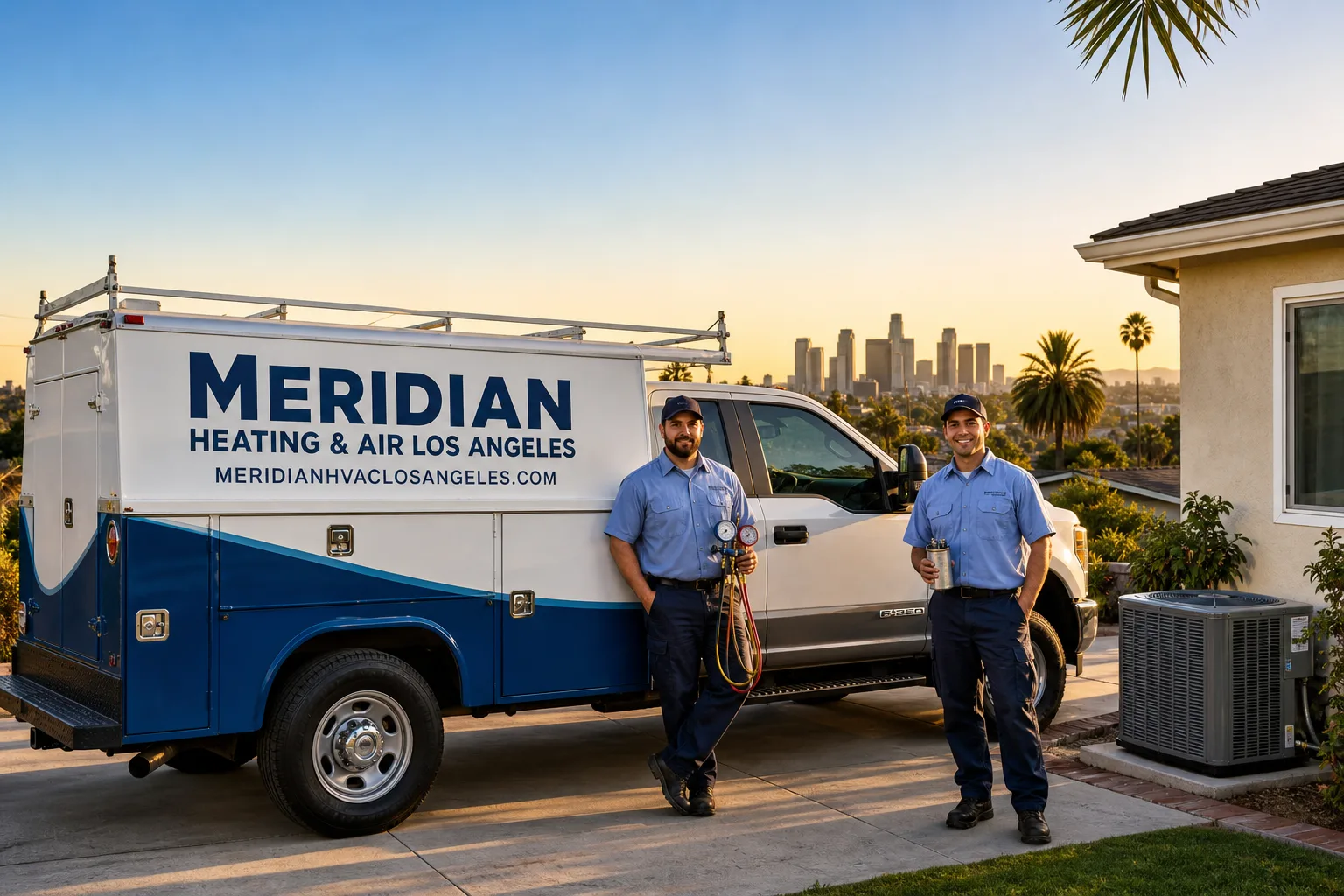
Fast, Reliable Heating & Furnace Across Big Bear Lake
Heating and furnace repair in Big Bear Lake typically runs $150–$700 for repairs and $3,500–$7,500 for full replacement, with most service calls completed same-day during the November through March heating season. At 6,752 feet elevation, every combustion furnace in Big Bear Lake must be altitude-derated to fire safely and efficiently — a requirement no lowland HVAC company encounters, but one we’ve handled for nearly two decades.
We’re Meridian Heating & Air Los Angeles, and our Heating & Furnace team makes the mountain run to Big Bear Lake when your system fails in the dead of winter. Anthony Moreno, our founder and lead installer, has spent 19 years working on furnaces at altitude — from the vintage propane units in original Moonridge cabins to newer installs in the condos near Snow Summit. We understand what breaks here, why it breaks, and how to fix it so it stays fixed through the next storm cycle. Call us at (877) 454-5066 for a free estimate.
Why Meridian Heating & Air Los Angeles Is Big Bear Lake’s Preferred Heating & Furnace Company
Big Bear Lake isn’t a market we dabble in — it’s a mountain we know. Our 286 verified reviews averaging 4.8 stars include calls we’ve answered on Pine Knot Avenue, Fox Farm Road, and in the rental districts near Bear Mountain. Customers mention Anthony by name because he’s the one who shows up, diagnoses the problem, and does the work.
Nearly two decades of hands-on HVAC experience means we’ve seen what altitude does to combustion equipment. We work on your brand — whether it’s a Trane, Lennox, Goodman, or Rheem — and we carry LP conversion kits and altitude-specific orifices because propane service is common in Big Bear Lake properties that sit beyond SoCalGas lines. From routine tune-ups to emergency calls at 10 PM with snow falling, we treat Big Bear Lake like the serious mountain environment it is.
Our Heating & Furnace Services in Big Bear Lake
Furnace Repair
Furnace repair in Big Bear Lake demands altitude literacy. That short-cycling, sooting, or no-heat call might trace to an improperly derated gas valve, a heat exchanger cracked from repeated cold starts, or a draft inducer iced over because snow blocked the flue termination. We diagnose combustion problems with a manometer and combustion analyzer, not guesswork. Most repairs run $150–$700 depending on whether we’re replacing an ignitor, a gas valve, or addressing a heat exchanger issue.

Furnace Replacement
When a 30-year-old propane furnace in a Moonridge cabin or a Fox Farm A-frame reaches the end of its service life, replacement isn’t just about swapping boxes. We size the new unit for derated BTU output at 6,752 feet, convert for propane if needed, and adjust manifold pressure and orifice size for clean combustion. A typical furnace replacement in Big Bear Lake runs $3,500–$7,500, including altitude-specific setup and LP conversion. Anthony handles the install personally — no rotating subcontractor crews.

Furnace Tune-Up
A tune-up in Big Bear Lake is preventive medicine against winter failure. We check heat exchanger integrity, combustion efficiency, gas pressure at altitude, and flue draft — the things that kill furnaces in mountain environments. With many Big Bear Lake properties sitting vacant between rental bookings, that first firing after weeks of disuse is when cracks reveal themselves and valves stick. Our tune-ups run $80–$200 and often catch the failure before it happens on a -10°F January night.

Heat Exchanger Inspection & Replacement
Heat exchanger failure is common in Big Bear Lake’s aging housing stock. Those 1950s–1980s wood-frame cabins with minimal insulation force furnaces to cycle longer and more frequently, and the repeated thermal shock of cold starts in vacant properties accelerates metal fatigue. A cracked heat exchanger is a safety issue — carbon monoxide risk in tight mountain construction. We inspect with cameras and combustion testing, and if replacement makes more sense than repair, we advise honestly.

What happens when you call
- 1
A real person answersNo phone trees — you reach a local pro.
- 2
You get an upfront price rangeHonest numbers before anyone is dispatched.
- 3
A background-checked tech heads outLicensed & insured, dispatched right away.
- 4
You approve before work beginsNothing starts until you say go.
Trusted Brands We Service in Big Bear Lake
We work on your brand — period. Our experience spans Trane, Lennox, Goodman, and Rheem among nine major manufacturers, and we stock common parts for faster turnaround on mountain service calls. Big Bear Lake’s isolation means waiting three days for a gas valve isn’t acceptable when snow is forecast. We carry altitude-rated components and LP conversion hardware because standard sea-level parts will fail here. Whether your furnace is a 1990s Rheem with a standing pilot or a newer Lennox with an electronic ignition, we’ve repaired and replaced it at elevation.
Common Heating & Furnace Problems We See in Big Bear Lake Homes
- Altitude-induced sooting and carbon monoxide risk. Furnaces installed without proper deration run rich, producing soot that corrodes heat exchangers and creates dangerous CO levels. We see this in cabins purchased from out-of-area owners who never knew their furnace was misconfigured for sea level.
- Heat exchanger cracks from cold-start thermal shock. Vacation rentals on Pine Knot Avenue and throughout Moonridge sit unheated for weeks, then get cranked to 70°F for incoming guests. That repeated expansion and contraction cracks exchangers in 15–25 year old units.
- LP gas valve failure from improper altitude orifice sizing. Propane systems are especially sensitive. An orifice drilled for 1,000 feet elevation delivers too much fuel at 6,752 feet, causing short cycling, yellow flame, and eventual valve damage.
- Draft inducer icing and flue blockage. Big Bear Lake’s 7–8 feet of annual snow packs against exterior flue terminations and intake pipes. We’ve answered calls where the furnace failed simply because snow blocked combustion air — but we’ve also seen inducer motors burn out from running blocked for days in an unoccupied cabin.
Pricing for Heating & Furnace in Big Bear Lake, CA
Here’s what heating and furnace service costs in Big Bear Lake’s market:
| Service | Price Range |
|---|---|
| Furnace Repair | $150 – $700 |
| Furnace Replacement | $3,500 – $7,500 |
| Tune-Up | $80 – $200 |
Altitude work adds complexity but not hidden cost — deration and LP conversion are part of proper installation, not upsells. What moves a repair toward the higher end: heat exchanger replacement, gas valve replacement on propane systems, or after-hours emergency calls during storm periods. Replacement pricing depends on BTU capacity (derated for altitude), efficiency rating, and whether we’re converting from natural gas to propane. We provide upfront pricing before any work begins, and estimates are always free. Call (877) 454-5066 to schedule.
We Also Serve Cities Near Big Bear Lake
Our mountain service area extends to Big Bear City, Lucerne Valley, Mentone, and Yucaipa. Whether you’re managing a rental portfolio across the San Bernardino Mountains or own a single cabin that needs reliable heat, we make the drive. Each community has its own altitude and fuel considerations — Lucerne Valley’s high desert, Mentone’s transitional zone — and we adjust our approach accordingly.
Serving Big Bear Lake, CA — Our Local Coverage Area
We’re based in the Big Bear Lake area and know this community well. Use the map below to see our service coverage — if you’re nearby, we can almost certainly help.
FAQs — Heating & Furnace in Big Bear Lake
Yes. At 6,752 feet, every gas or propane furnace must be altitude-derated because combustion efficiency drops roughly 4% per 1,000 feet above 2,000 feet — a net loss of about 19% usable capacity. An underrated 100,000 BTU furnace effectively delivers only 81,000 BTU, risks sooting, carbon monoxide production, and premature heat exchanger failure. We check deration on every service call and correct it on every install. Call (877) 454-5066 if you’re unsure whether your current furnace was properly configured.
Short-cycling at Big Bear Lake’s altitude almost always traces to improper fuel-air mixture, typically from orifices sized for sea level or low elevation. Too much propane relative to oxygen creates incomplete combustion, overheating the exchanger and triggering safety limits. We measure manifold pressure and combustion gases with calibrated instruments, then resize orifices and adjust gas valve output for 6,752 feet. Call (877) 454-5066 — this isn’t a filter change, it’s a combustion safety issue.
Replace it. A 30-year-old furnace in a Big Bear Lake rental cabin has exceeded its design life, especially if it’s seen the deferred maintenance common in second homes. Heat exchanger failure risk rises sharply after 20 years, and parts availability for pre-1990 units is increasingly problematic. Replacement with a properly derated, altitude-configured unit eliminates liability, improves efficiency, and avoids the 2 AM emergency call during peak rental season. We offer free replacement estimates — call (877) 454-5066.
Yes, and it’s common in Big Bear Lake where SoCalGas service doesn’t reach many properties. Conversion requires LP orifices, gas valve pressure adjustment, and combustion verification at altitude — not a DIY kit. We handle conversions routinely, sizing everything for 6,752 feet elevation. Call (877) 454-5066 to discuss whether your existing furnace is a viable candidate or if replacement makes more sense.
Cold starts after extended vacancy stress every component. Residual moisture in heat exchangers and burners freezes, expansion and contraction from rapid heating cracks aged metal, and snow often blocks flue or intake terminations without anyone noticing. We recommend a pre-season tune-up and, for rental properties, a freeze-stat or smart thermostat that maintains minimum temperature and alerts you to failures. Call (877) 454-5066 to set up winter-ready service.
Written by Anthony Moreno, Owner at Meridian Heating & Air Los Angeles, serving Big Bear Lake and the San Bernardino Mountains since 2005.