
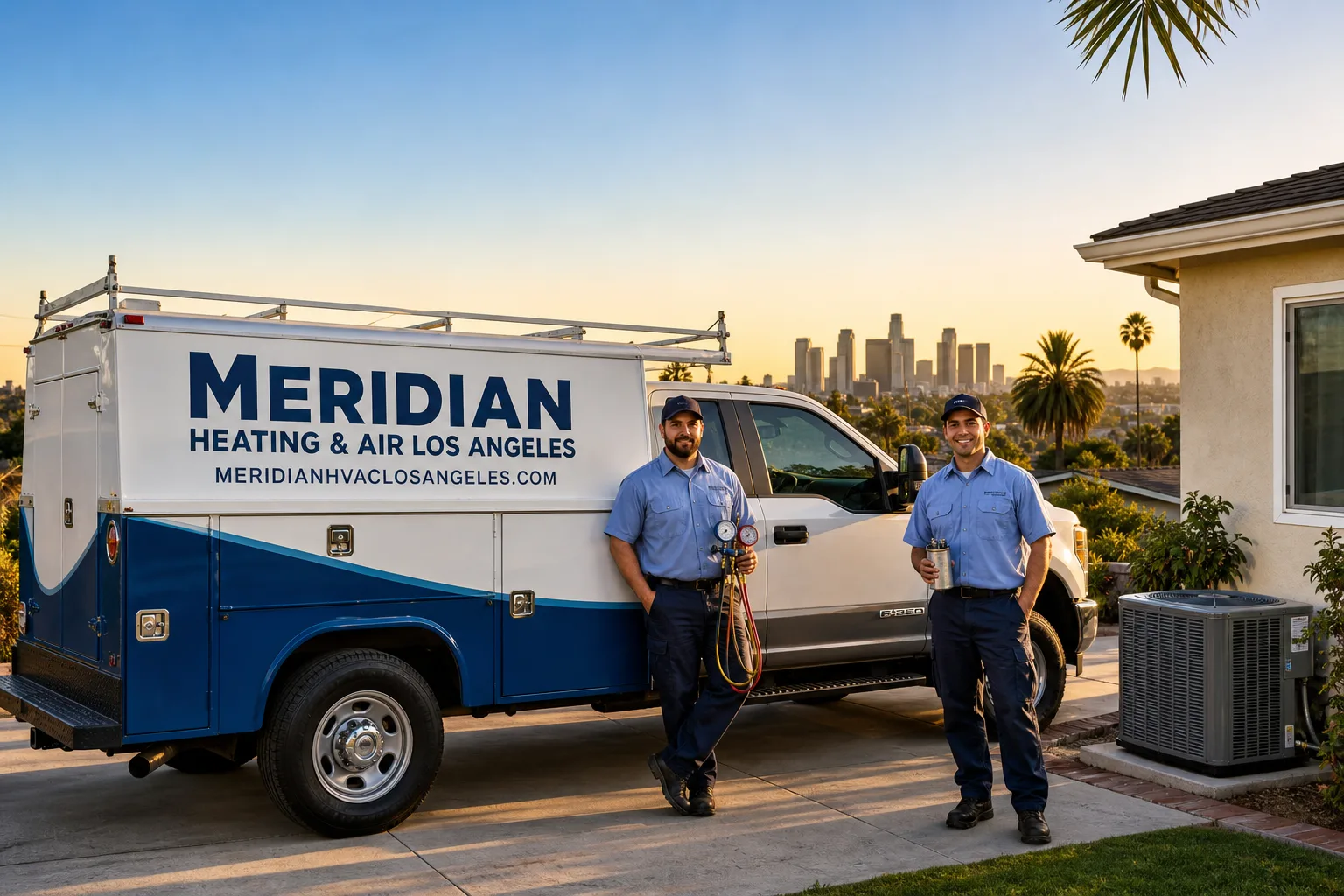
Fast, Reliable Heating & Furnace Across Sunland
When your furnace quits on a 28°F January night in Sunland, you need someone who knows the Tujunga Valley’s brutal temperature swings, not a dispatcher reading from a generic LA script. We’re Meridian Heating & Air, and we’ve been driving out to Sunland since 2006 — up the 210, through La Crescenta, and into the canyon mouth where standard HVAC rules don’t apply. Our Heating & Furnace team handles everything from ignitor replacements on 1960s ranch units to full heat exchanger swaps in homes that sit directly in the Santa Ana bellows. Call (877) 454-5066 for a free estimate, or keep reading to see why Sunland’s geography demands a different approach to heating.
Why Meridian Heating & Air Los Angeles Is Sunland’s Preferred Heating & Furnace Company
Nearly two decades of hands-on HVAC experience means we’ve watched Sunland’s furnace problems evolve. Anthony Moreno, our founder, still shows up on the job — lead installer on new systems, lead technician on the calls that stump everyone else. That 1957 ranch on Foothill Blvd with the double ignitor failure? Anthony diagnosed the canyon dust infiltration himself, specified the sealed Honeywell ignitor, and oversaw the MERV cabinet install.
286 customers and counting have left reviews averaging 4.8 stars. The feedback we hear most from Sunland homeowners isn’t about price — it’s about showing up prepared. When you’ve already had two technicians out who sized your system to Burbank specs and it still can’t handle an August Santa Ana, you want the guy who’s seen that exact failure pattern before.
We work on your brand. Goodman, Rheem, York, Daikin — we’ve got factory training or field experience on all nine major lines, so we’re not pushing you toward whatever’s in the warehouse. From routine tune-ups to emergency calls at 10 PM on a freezing night, one company covers every scenario.
Our Heating & Furnace Services in Sunland
Furnace Repair
Furnace repair in Sunland runs $175–$825, with most calls landing in the $250–$450 range. The Tujunga Valley’s extreme heat variance — 105°F summers down to 28°F winters — fatigues heat exchanger metal faster than coastal systems ever see. We regularly find cracks in 15-year-old units that should have lasted 20, simply because the metal’s been expanding and contracting through a 70-degree wider annual swing than Santa Monica equipment faces. When we repair a furnace on Oro Vista Avenue or Glenoaks Boulevard, we inspect the heat exchanger with a borescope every time, no exceptions. Canyon dust also fouls flame sensors and pressure switches; we clean or replace them with sealed components built for gritty environments.

Furnace Replacement
Replacing a furnace in Sunland means sizing for the bellows effect, not standard LA Manual J tables. We’ve seen too many systems installed by contractors who pulled permits using flatland specs, then watched homeowners suffer through January nights when the unit couldn’t keep up. Anthony Moreno personally measures each home’s heat load, factors the canyon wind exposure, and specifies equipment with enough capacity for the valley’s worst cold snaps. Installations typically run $4,130–$8,850 depending on duct modifications — many Sunland ranches need duct resizing to handle modern airflow requirements. We handle permits, haul-away, and full commissioning, and Anthony signs off on every install.

Furnace Tune-Up
A furnace tune-up in Sunland isn’t a generic 21-point checklist. It’s $95–$235 of targeted preparation for a system that’s about to work harder than its designers probably intended. We pull and inspect the blower assembly for wildfire smoke residue — after the 2020 Bobcat Fire, we saw filters loaded with fine particulate that restricted airflow and caused heat exchanger overheating. We test ignition under simulated wind conditions, check gas pressure across the firing range, and measure temperature rise against manufacturer specs. For homes near Big Tujunga Canyon Road or up against the Angeles National Forest boundary, we recommend twice-yearly filter changes minimum. One tune-up in October, before the Santa Anas start driving dust through every gap in the envelope.

Heat Exchanger Inspection & Replacement
Heat exchanger failure is the repair we never want to find, and the one we’re most vigilant about in Sunland. The extreme thermal cycling here — summer metal at 180°F, winter metal contracting in 28°F ambient — creates fatigue cracks years earlier than in moderate climates. We inspect with visual borescope and combustion analysis on every service call. If we find cracks, we red-tag the furnace immediately: carbon monoxide risk isn’t negotiable. Replacement cost varies significantly based on furnace age and accessibility; call (877) 454-5066 for exact pricing after inspection. Many Sunland ranches have furnaces in tight attic spaces or converted closet installations that complicate the swap, so we quote only after seeing the job.

Ignitor Replacement
The field vignette says it all: we serviced a 1957 ranch on Foothill Blvd near the Big Tujunga Wash where the furnace ignitor failed twice in one season. The Santa Ana bellows had sucked in fine grit from the canyon, fouling the burner assembly. We replaced the ignitor with a sealed Honeywell model and installed a high-MERV filter cabinet to stop canyon dust ingress — haven’t had a callback since. Standard ignitors last 3–5 years in clean environments; in Sunland’s dust-driven conditions, we see 18-month failures on unprotected systems. We stock sealed hot-surface ignitors and intermittent pilot assemblies for Rheem, Goodman, and York units common in local housing stock.

Gas Valve Repair
Gas valve problems in Sunland often trace to debris in the manifold or corrosion from humidity swings. The same Santa Anas that bake the valley in August drop humidity to desert levels, then winter rains spike it. We see sticking valves on 20-year-old furnaces in the post-WWII ranch core, and we carry replacement valves for all major brands. Safety check: if you smell gas near your furnace, leave the home and call your utility first, then us. We don’t touch gas line repairs without proper leak verification.

What happens when you call
- 1
A real person answersNo phone trees — you reach a local pro.
- 2
You get an upfront price rangeHonest numbers before anyone is dispatched.
- 3
A background-checked tech heads outLicensed & insured, dispatched right away.
- 4
You approve before work beginsNothing starts until you say go.
Trusted Brands We Service in Sunland
We work on your brand — Goodman, Rheem, York, Daikin, and five others. Our van stocks the most common ignitors, flame sensors, and gas valves for Sunland’s most prevalent equipment, which skews toward Goodman and Rheem in the 1990s–2010s install wave, with newer Daikin systems appearing in recent retrofits. If we don’t have your part, our Sunland Valley supplier relationships mean next-day availability for most components, not a week waiting for a warehouse shipment from Ontario. Anthony’s factory training on all nine lines means he recognizes failure patterns specific to each manufacturer’s design — the cracked Rheem heat exchanger at year 14, the Goodman pressure switch vulnerability to dust, the York ignition module that fails after three hard Santa Ana seasons.
Common Heating & Furnace Problems We See in Sunland Homes
- Santa Ana wind ignitor failure. The bellows effect pulls canyon dust through every vent and gap, coating flame sensors and eroding hot-surface ignitors. We replace with sealed components and upgrade filtration — standard LA service doesn’t address this.
- Heat exchanger fatigue from extreme thermal cycling. Sunland’s 70°F+ annual temperature swing cracks metal faster than coastal climates. We inspect every visit and won’t let a cracked exchanger keep running.
- Wildfire smoke blower overload. The 2020 Bobcat Fire and subsequent seasons loaded filters with fine particulate, choking airflow and causing heat exchanger overheating. We check blower amp draw and filter loading as standard practice.
- Undersized ductwork in retrofitted ranches. Post-WWII homes on streets like Honolulu Avenue or Elizondo Avenue were never designed for central heating. Add-on systems from the 1980s–90s often run through 4-inch duct that can’t move enough CFM for modern furnace output.
Pricing for Heating & Furnace in Sunland, CA
Here’s what heating and furnace work actually costs in Sunland’s market. These are the ranges we quote after seeing the job, not bait-and-switch numbers that balloon on arrival.
| Service | Price Range |
|---|---|
| Furnace Repair | $150–$700 |
| Furnace Tune-Up | $80–$200 |
| Heat Exchanger Replacement | $0–$0 |
What moves you within these ranges? Accessibility matters — furnaces in tight Sunland attics or converted closets take longer. Parts availability: we stock common components, but a failed control board on a 25-year-old unit may need sourcing. And the underlying condition: a furnace that’s never been tuned in a dust-heavy environment usually needs more corrective work than one we’ve maintained annually. We quote upfront, before any work starts. Estimates are free — call (877) 454-5066.
We Also Serve Cities Near Sunland
Our service radius covers the full Tujunga Valley and surrounding communities. We regularly run calls to Shadow Hills for horse-property HVAC systems, Tujunga for canyon-adjacent homes with similar bellows-effect problems, La Crescenta-Montrose for hillside installations, and Burbank for commercial and residential clients who need the same owner-led expertise without the franchise markup. Each microclimate gets its own assessment — what works in flatland Burbank often fails in Sunland’s canyon mouth.
Serving Sunland, CA — Our Local Coverage Area
We’re based in the Sunland area and know this community well. Use the map below to see our service coverage — if you’re nearby, we can almost certainly help.
FAQs — Heating & Furnace in Sunland
Sunland furnaces face canyon dust infiltration, wildfire smoke loading, and extreme thermal cycling that flatland LA systems never see. Our tune-ups include blower inspection for particulate buildup, ignition testing under simulated wind conditions, and filter cabinet evaluation for dust sealing. Standard 21-point checklists miss these failure modes. Call (877) 454-5066 to schedule — estimates are free.
Yes, we regularly service and repair mid-century furnaces in Sunland’s post-WWII ranch core, including units on Foothill Boulevard and Glenoaks Boulevard. Parts availability varies by manufacturer, but we’ve sourced replacement gas valves, thermocouples, and blower motors for systems built as early as the 1940s. Anthony Moreno evaluates whether repair or replacement makes financial sense based on efficiency gains and safety. Call for an assessment.
We install and service all major brands, but for Sunland specifically we favor equipment with sealed combustion, high-static blower capability for restrictive ductwork, and heat exchanger warranties that cover thermal fatigue. Goodman, Rheem, and York units with two-stage gas valves handle the valley’s temperature swings better than single-stage equipment. Daikin’s modulating furnaces excel in homes with duct modifications. We match the brand to your home’s specifics, not our warehouse inventory.
Replace in spring or fall if your furnace is 15+ years old, has required two repairs in two years, or has a cracked heat exchanger. Sunland’s September Santa Anas can hit before you’re ready, and emergency January replacements cost more and limit your equipment choices. If your system is running well after a clean tune-up, another season may be fine. Anthony Moreno gives straight assessments — no upsell pressure. Call (877) 454-5066 for an honest evaluation.
Once yearly minimum, preferably in October before Santa Ana season. Homes near Big Tujunga Canyon Road or directly exposed to canyon winds benefit from twice-yearly checks — October and March. Wildfire smoke years warrant an extra filter and blower inspection regardless of schedule. Our tune-up catches the dust-driven failures that standard maintenance misses.
Written by Anthony Moreno, Owner at Meridian Heating & Air Los Angeles, serving Sunland and the Tujunga Valley since 2006.