
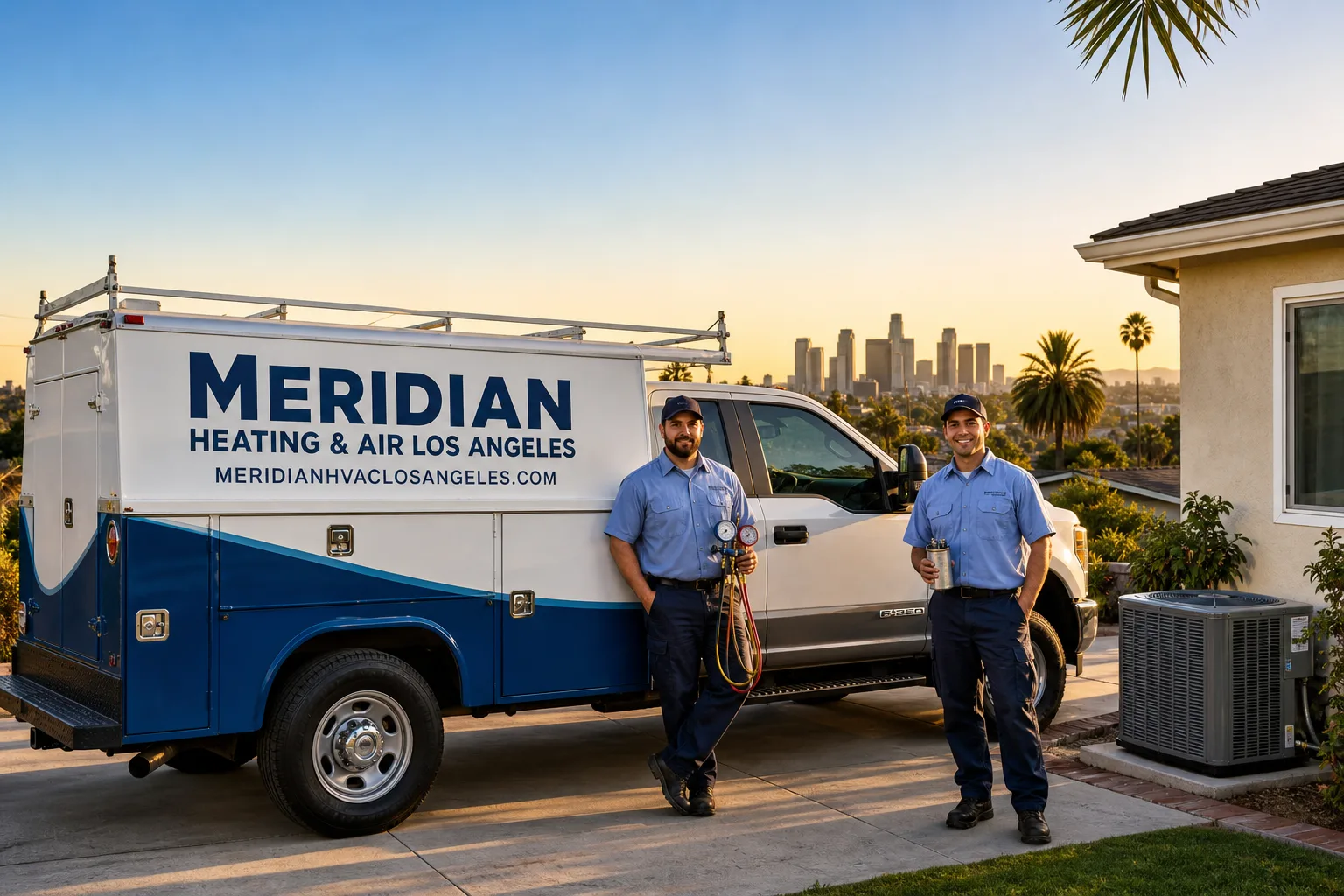
Fast, Reliable Air Quality & Ventilation Across Chinatown
Chinatown’s ventilation problems aren’t like anywhere else in San Francisco. The combination of salt-laden fog rolling in from the Bay and grease-laden exhaust from one of America’s most restaurant-dense neighborhoods means your air quality system faces a unique double assault. We’re Meridian Heating & Air, and we’ve spent nearly two decades solving exactly these problems in buildings just like yours. Anthony Moreno, our founder and lead installer, still shows up on the job — not a rotating subcontractor, but the same hands-on expertise on every call. If your apartment smells like the restaurant downstairs, your ERV is clogged again, or your pre-war building simply can’t breathe, call us at (877) 454-5066. We know the alleys, the access points, and the code realities of 94133.
Why Meridian Heating & Air Los Angeles Is Chinatown’s Preferred Air Quality & Ventilation Company
We’ve earned our reputation here one building at a time. Our Air Quality & Ventilation team has worked on the narrow brick structures along Grant Avenue, the mixed-use walk-ups on Stockton Street, and the tight alley-access buildings on Waverly Place. Anthony doesn’t delegate to an anonymous crew — he’s the one climbing the stairs, measuring the ductwork, and explaining your options face to face.
286 customers have left reviews averaging 4.8 stars, and that score reflects nearly two decades of continuous operation, not a flash-in-the-pan marketing push. When a Chinatown landlord calls us about persistent tenant complaints, we understand the urgency. Restaurant grease doesn’t wait. Mold from inadequate ventilation spreads. Our response prioritizes 94133 because we know the building stock and the failure patterns.
We work on your brand. Our experience spans Carrier, Trane, Lennox, Goodman, Rheem, York, Daikin, Bryant, and American Standard — so when your existing system needs repair or replacement, we’re not forcing a single product line on you. From routine tune-ups to emergency calls, one company handles every scenario.
Our Air Quality & Ventilation Services in Chinatown
ERV/HRV System Installation & Service
Energy Recovery Ventilators and Heat Recovery Ventilators are critical in Chinatown’s pre-1930s buildings, where original construction never accounted for modern air exchange requirements. But here’s the local reality: grease fouling from restaurant exhaust clogs ERV/HRV cores faster here than anywhere else we serve. We serviced a mixed-use building on Waverly Place where a Carrier ERV system was clogged with greasy residue from adjacent restaurant exhaust, causing persistent indoor air quality complaints. Our crew installed a grease-resistant pre-filter and relined the ductwork with coated metal, restoring ventilation without disrupting the residential units above. For new ERV/HRV installations in Chinatown, we specify corrosion-resistant components and accessible filter locations because we know you’ll be cleaning them often.

Ventilation Install & Repair
New ventilation installation in Chinatown means working with buildings that have no dedicated mechanical chases, extremely narrow access points, and structural constraints from 1907-1930 brick and wood-frame construction. We’ve retrofitted ductwork through closets, soffits, and existing chimney flues because there’s no other path. Salt-air corrosion on outdoor condenser coils leads to fin degradation and refrigerant leaks within 3-5 years here — a timeline compressed by the marine microclimate that rarely exceeds 65°F even in summer. Our ventilation repairs address the root cause, not just the symptom, because we’ve seen what happens when grease and salt converge on the same rooftop equipment.

Air Filtration Upgrades
Standard filters don’t last in Chinatown. The particulate load from dense commercial cooking, combined with coastal moisture that turns ordinary dust into adhered grime, means filtration systems need more frequent attention and higher-specification media. We size upgrades for actual load conditions, not textbook calculations. A MERV 13 that works fine in Noe Valley may clog in weeks here. We specify appropriate filtration for mixed-use environments, with pre-filtration stages where grease is present, and we stock replacement media sized for the common forced-air retrofits we see in 94133’s 3-to-5-story buildings.

UV Air Purifier Installation
UV-C systems target the biological growth that thrives in Chinatown’s persistently damp, poorly ventilated spaces. Inadequate ventilation in pre-1930s buildings causes mold growth in crawl spaces and attics, contaminating ductwork — we’ve found active mold in systems where residents had no idea the problem existed. UV purifiers installed at the coil and in the return ductwork interrupt that cycle. Installation requires careful placement in constrained mechanical spaces, and we know how to fit these systems into Chinatown’s tight access realities without damaging historic fabric.

Humidifier & Dehumidifier Install
Chinatown’s climate paradox: cool, foggy summers that rarely need cooling, but persistent moisture infiltration that drives chronic humidity problems. Whole-home dehumidification often makes more sense here than traditional air conditioning, especially in ground-floor and basement units where moisture accumulates against foundation walls. We size dehumidifiers for actual latent loads, not square-footage rules of thumb, because a 900-square-foot Chinatown apartment with poor envelope sealing behaves differently than a sealed suburban home. Humidifiers see less demand here but matter for the dry winter periods when heating systems run continuously.

What happens when you call
- 1
A real person answersNo phone trees — you reach a local pro.
- 2
You get an upfront price rangeHonest numbers before anyone is dispatched.
- 3
A background-checked tech heads outLicensed & insured, dispatched right away.
- 4
You approve before work beginsNothing starts until you say go.
Trusted Brands We Service in Chinatown
We work on your brand — whatever’s on your rooftop or in your basement, we’ve likely serviced it before. Our hands-on experience covers Rheem, York, Daikin, Bryant, and five other major manufacturers, meaning we stock common parts and can source specialized components without the delays that leave Chinatown tenants breathing bad air for extra days. Anthony’s factory training and field experience across this breadth means diagnostic accuracy on the first visit, not a return trip because the wrong part was ordered. For the mixed-use buildings that dominate 94133, that efficiency matters — restaurant downtime is expensive, and residential complaints escalate fast.
Common Air Quality & Ventilation Problems We See in Chinatown Homes
- Grease-clogged ventilation in mixed-use buildings. Ground-floor restaurants on Grant Avenue and Stockton Street vent directly below residential units with shared wall cavities and inadequate fire separation. The result: cooking odors, grease accumulation in ductwork, and accelerated filter loading that standard maintenance schedules can’t keep up with.
- Salt-air corrosion on rooftop equipment. Chinatown’s northeastern exposure catches fog and salt spray that inland neighborhoods avoid. Condenser coils, fan motors, and control enclosures degrade visibly faster — we’ve replaced equipment in 94133 that would have lasted years longer in the Mission District or Noe Valley.
- Mold from chronic moisture in unventilated spaces. Original gravity floor furnaces and steam radiators left voids and chases that modern construction would seal. Those cavities trap moisture against century-old framing, creating mold reservoirs that distribute spores through any available air path.
- ERV/HRV core fouling from combined grease and salt. The narrow alleys like Waverly Place and Ross Alley channel grease-laden exhaust from dozens of adjacent restaurants directly across rooftops and building facades, causing accelerated grease fouling and corrosion on any outdoor HVAC condenser or ventilation equipment — a failure mode a technician in the Richmond or Sunset would rarely encounter but is routine here.
Pricing for Air Quality & Ventilation in Chinatown, CA
Honest numbers for actual work in 94133. These ranges reflect the access challenges, grease-protection requirements, and corrosion-resistant specifications that Chinatown’s conditions demand:
| Service | Price Range in Chinatown |
|---|---|
| ERV/HRV Installation | $3,500–$7,500 |
| Ventilation System Repair | $150–$650 |
| Air Filtration Upgrade | $80–$200 |
What moves the needle within these ranges: building height and access difficulty (rooftop crane vs. stair carry), existing ductwork condition (grease-damaged sections need replacement, not cleaning), and whether we’re matching to existing controls or upgrading to modern automation. Every estimate we provide is free and specific to your building — no generic quotes that balloon once we’re on site. For exact pricing on your Chinatown property, call (877) 454-5066.
We Also Serve Cities Near Chinatown
Our service radius extends throughout San Francisco’s core neighborhoods. We regularly work in the Mission District, where building stock and ventilation challenges differ significantly from Chinatown’s pre-war density. Noe Valley‘s hillside homes present their own access and moisture management questions. Visitacion Valley‘s industrial-residential mix requires yet different expertise. Wherever you are in San Francisco, the same owner-led approach applies — Anthony shows up on the job, not a dispatched stranger.
Serving Chinatown, CA — Our Local Coverage Area
We’re based in the Chinatown area and know this community well. Use the map below to see our service coverage — if you’re nearby, we can almost certainly help.
FAQs — Air Quality & Ventilation in Chinatown
Your building sits in one of America’s most restaurant-dense urban blocks, and grease-laden exhaust from ground-floor commercial kitchens rises through shared wall cavities, rooftop proximity, and inadequate separation between systems. We address this with grease-resistant pre-filters, coated ductwork linings, and more frequent maintenance intervals than standard manufacturer recommendations. Call (877) 454-5066 for a free assessment of your specific building’s exposure.
In 94133’s mixed-use environment, check ERV pre-filters monthly and replace them every 6–8 weeks during heavy cooking periods, rather than the standard 3-month interval. The grease load here is simply higher than residential-only buildings. We set up maintenance schedules calibrated to actual Chinatown conditions, not generic guidelines.
Yes, a properly sized dehumidifier will control the moisture that fuels mold growth, but only if ventilation improvements address the source of damp air infiltration. In Chinatown’s pre-1930s buildings, we often find foundation seepage combined with inadequate exhaust — the dehumidifier handles the symptom while we fix the airflow. Call (877) 454-5066 for a free estimate on integrated moisture control.
Yes, we install UV-C systems in historic Chinatown buildings regularly, working within constrained mechanical spaces and preserving architectural fabric. The key is proper placement for exposure time and accessibility for annual lamp replacement — factors we account for during sizing, not after installation.
An ERV with grease-resistant pre-filtration, separated exhaust streams for commercial and residential zones, and corrosion-protected outdoor components best handles Chinatown’s unique combination of salt air and restaurant density. We design for your specific building layout, not a template, because Waverly Place access differs from Stockton Street access, and restaurant type affects grease load. Call (877) 454-5066 to discuss your mixed-use building’s requirements.
Written by Anthony Moreno, Owner at Meridian Heating & Air, serving Los Angeles since 2005.