
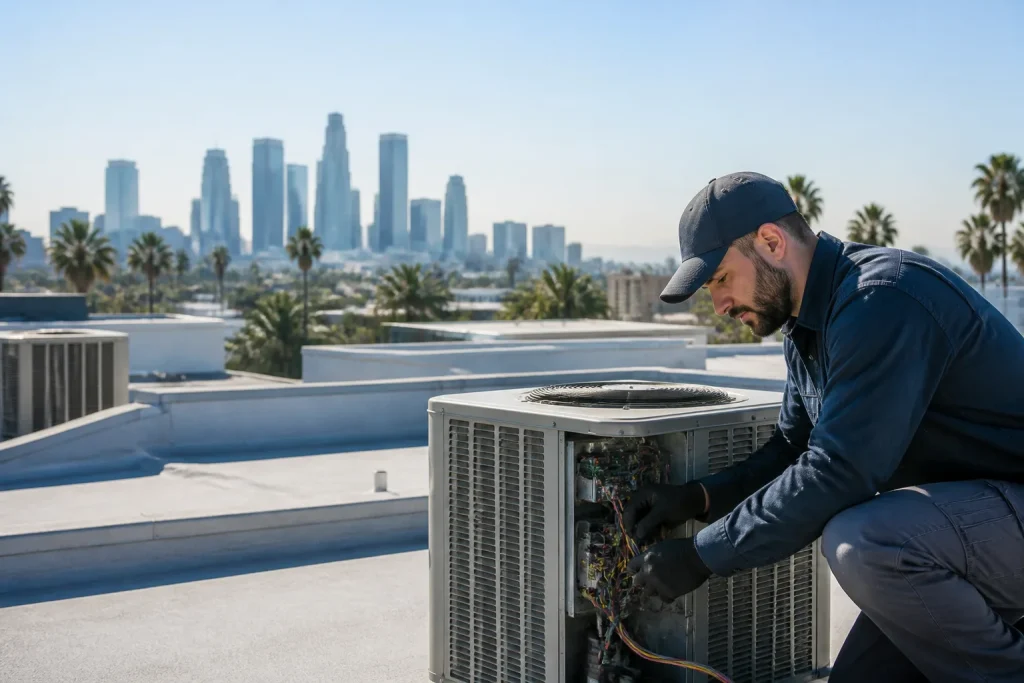
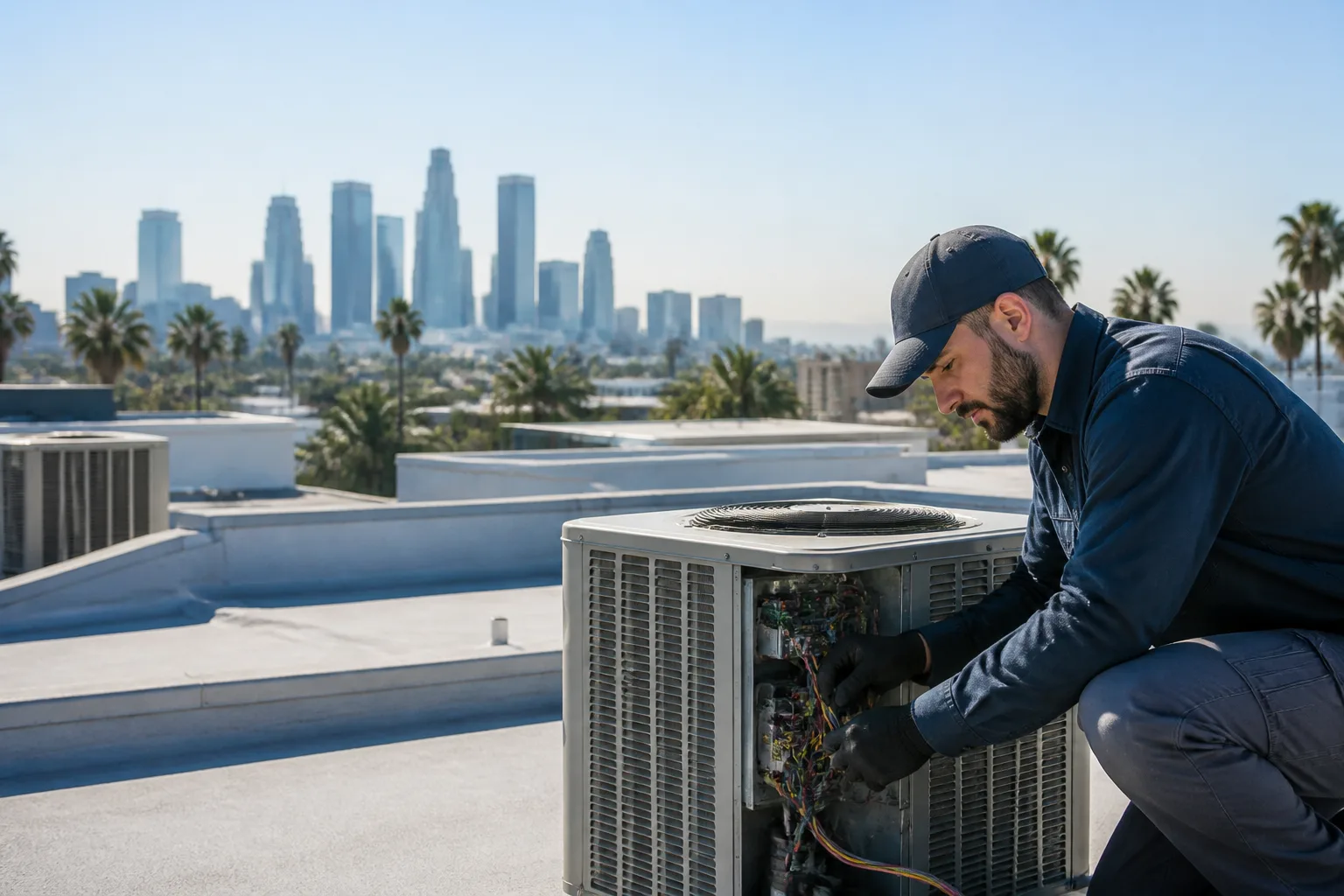
AC Repair & Installation: Repair or Replace? How Los Angeles Homeowners Decide
Most Los Angeles homeowners facing a broken AC get told the same rule: replace if the repair costs more than half what a new unit would run you. That sounds tidy, but in our 19 years on the job, we’ve seen a $900 compressor repair save a 7-year-old Bryant for another eight seasons, and we’ve seen a $400 capacitor swap turn into a $2,800 death spiral on a 15-year-old R-22 system. The real decision hinges on what failed, how old the unit is, and whether your technician is looking at your actual system or reading from a sales script. If you’d rather skip the guesswork, call us at (877) 454-5066 for a free, no-pressure estimate.
Why the $5,000 Rule Fails in Real Life
The internet loves the $5,000 rule: multiply your unit’s age by the repair cost, and if the total exceeds $5,000, replace it. A 12-year-old unit needing a $600 repair scores 7,200, so replace. Easy.
Except it isn’t. That formula treats a capacitor replacement the same as a cracked heat exchanger. It ignores that Los Angeles runs AC harder than almost any U.S. city, with cooling loads that stress compressors and condenser fans for six straight months. A 10-year-old unit in Santa Monica’s marine layer ages differently than one in Woodland Hills baking against the Santa Monica Mountains.
Here’s what actually matters:
- The specific component that failed. Capacitors, contactors, and fan motors are wear items. Compressor failure, refrigerant leaks, or a cracked heat exchanger signal deeper trouble.
- Repair history. One major repair in 12 years? Different story than three service calls in 18 months.
- Refrigerant type. R-22 systems are money pits now. The refrigerant was phased out in 2020, reclaimed stocks are dwindling, and prices per pound have quadrupled since 2015.
- Energy costs. A 14 SEER replacement versus a 10 SEER dinosaur in Los Angeles can shave $40–$80 off summer electric bills. Over 10 years, that’s real money.
We were in a garage over in Encino last month where a homeowner had been quoted $3,200 for a compressor replacement on a 13-year-old Goodman. We found a leaking suction line instead, fixed it for $340, and the unit’s running fine. The $5,000 rule would’ve sent that system to the scrap heap for no reason.
Component Failures: What Each One Actually Means
Not all breakdowns are created equal. Here’s how we think about the common ones:
Capacitor or contactor failure. These are the fuses of the AC world. They die from heat cycling, and Los Angeles delivers plenty of that. $150–$400 repair, usually worth doing on any unit under 15 years. If your tech is pushing replacement over a capacitor, get a second opinion.
Condenser fan motor. $400–$800 installed. Worth it on units under 12 years unless the compressor’s already noisy or the coils are rotted out from coastal salt air. We’ve replaced fan motors on 10-year-old Daikin systems in Redondo Beach that ran another five years.
Compressor failure. This is the big one. $1,800–$3,500 depending on size and accessibility. On a unit under 8 years, we usually repair if the rest of the system is clean. Over 12 years? The compressor is the heart, and when it goes, other organs usually follow. That said, we repaired a 9-year-old American Standard in Pasadena last summer because the homeowner had maintenance records showing clean coils and good airflow. Still running.
Refrigerant leak (evaporator or condenser coil). Leaks in copper linesets can be patched. Leaks in aluminum evaporator coils often mean replacement, and on R-22 systems, that means converting to R-410A or replacing the whole unit. In Los Angeles, where we see coil corrosion from smog and coastal moisture, this is a common end-of-life trigger.
Cracked heat exchanger (furnace). Safety issue, full stop. No reputable tech will patch this. If your furnace is over 12 years old, you’re replacing the furnace, and often the paired AC makes sense to match.
How Los Angeles Climate Changes the Math
National HVAC advice assumes moderate cooling seasons. Los Angeles doesn’t have those. From May through October, many neighborhoods see daily highs above 85°F, with inland valleys hitting 100°F+ for weeks straight. That matters for repair-or-replace decisions in specific ways:
- Runtime hours pile up fast. A Los Angeles AC accumulates 1,800–2,200 cooling hours annually versus 600–900 in milder climates. A 10-year-old unit here has the wear of a 15–18-year-old unit in Seattle or San Francisco.
- Heat stress kills compressors. Extended 95°F+ days force compressors to work at maximum load for hours. That’s when latent defects turn into failures. We see compressor deaths spike in August and September in the San Fernando Valley.
- Coastal corrosion is real. Santa Monica, Marina del Rey, Long Beach: salt air eats condenser fins and electrical connections. A 12-year-old coastal unit often looks 18 inside the cabinet.
- Inland dust and Santa Ana winds. Glendale, Burbank, the eastern Valley: fine dust clogs coils and stresses blower motors. Maintenance helps, but the cumulative load is higher than national averages assume.
What this means practically: we use shorter age thresholds than national guides suggest. A well-maintained 12-year-old unit in a mild climate might have 5 years left. In Los Angeles, we’d call that 2–4 years depending on location and history. Not automatic replacement, but a factor in whether a $2,000 repair makes sense.
The R-22 Problem: Why Refrigerant Type Matters More Than Age
If your AC was installed before 2010, there’s a good chance it runs on R-22 refrigerant. The EPA phased out production in 2020, and while reclaimed R-22 is still available, prices have gone from $30/lb to $120–$180/lb in the Los Angeles market. A typical residential system holds 5–10 pounds, so a “simple” refrigerant recharge can run $600–$1,800 before you even fix the leak.
Here’s where technicians disagree honestly. Some of us, including our shop, will still service R-22 systems if the leak is repairable and the customer understands the economics. Others push replacement automatically. Both positions can be defensible, but the key is transparency.
Questions to ask any tech who says you need a new system:
- Is the leak in the lineset, the evaporator, or the condenser? (Lineset = often patchable; evaporator on R-22 = usually replacement time)
- What’s the total cost including refrigerant, and what’s the warranty?
- If I repair, what’s the realistic lifespan before the next major issue?
We repaired a 2006 York system in Silver Lake last year with a lineset leak. Total bill: $890. The homeowner knew it might be the last repair, but wanted one more season to budget for replacement. That’s a valid choice when the numbers are honest.
Questions That Separate Honest Advice From an Upsell
After 19 years and 286 reviews, we’ve learned that homeowners often know more than they think. They just need the right questions. Here’s what to ask any technician recommending replacement:
- “Can you show me the failure?” A cracked heat exchanger should be visible on camera. A compressor amp draw should be documented. If they won’t show you, that’s a flag.
- “What would you do if this were your mother’s house?” Corny but effective. It forces specificity over script.
- “What’s the repair warranty, and what’s the replacement warranty?” A 1-year repair warranty versus a 10-year parts warranty on new equipment changes the risk calculation.
- “Are there intermediate options?” Sometimes a coil replacement, a hard start kit, or even just a thorough cleaning buys 2–3 years. A tech who only offers binary repair/replace may be selling, not diagnosing.
- “What’s the efficiency difference?” In Los Angeles, going from 10 SEER to 16 SEER can mean $500–$900 annual savings. That’s real replacement value. Going from 14 SEER to 15 SEER? Marginal.
We tell our customers: the right answer is the one that fits your budget, your timeline, and your tolerance for risk. Our job is to give you honest numbers, not to make the call for you. That’s why Anthony still shows up on the job, not just to install but to explain what we’re seeing.
When Financing a Replacement Actually Costs Less
This is the conversation homeowners dread, but sometimes the math is surprising. If you’re facing a $2,500 repair on a 14-year-old R-22 system, and you know you’ll replace within 3–5 years anyway, financing can be the cheaper path.
Example from a real call in Northridge: $2,800 compressor repair on a 2009 system, plus likely $400–$600 in refrigerant. Or $6,200 for a new 16 SEER American Standard with 10-year parts warranty, financed at $89/month. Over 36 months, the financed replacement costs $3,204. The repair would’ve been $3,200–$3,400 with no warranty on the compressor and an aging system. The homeowner chose replacement, and her summer electric bill dropped $67/month.
We’re not a finance company and we don’t push payment plans, but we do the math when asked. Sometimes repair is the smart play. Sometimes replacement is. The dishonest move is pretending only one answer exists.
Related Services in Los Angeles
If you’re weighing repair versus replacement, you might also need Meridian Heating & Air Los Angeles home for a full system evaluation, or if you’re considering expanded options, our AC Repair & Installation in Sacramento page covers similar climate considerations for the Central Valley. For heating system decisions, see Heating & Furnace in Sacramento, and for ductless alternatives, Heat Pump & Mini Split in Sacramento explains when mini splits beat central air.
What happens when you call
- 1
A real person answersNo phone trees — you reach a local pro.
- 2
You get an upfront price rangeHonest numbers before anyone is dispatched.
- 3
A background-checked tech heads outLicensed & insured, dispatched right away.
- 4
You approve before work beginsNothing starts until you say go.
The Bottom Line
Here’s what we’ve learned from nearly two decades of AC repair and installation in Los Angeles:
- Component matters more than cost. A cheap repair on the wrong part is expensive. An expensive repair on the right part is an investment.
- Los Angeles climate ages units faster than national averages suggest. Add 30–50% to standard lifespan estimates.
- R-22 systems need a clear-eyed cost projection, not just a repair quote.
- The best technicians explain options, don’t dictate them.
- Financing isn’t automatically bad math. Run the 3-year numbers.
At Meridian Heating & Air, we don’t do sales scripts. Anthony Moreno, our founder and lead installer, still diagnoses systems himself because the repair-or-replace call depends on what he’s actually seeing in your garage or on your roof. If you’re in Los Angeles and staring at a repair quote that doesn’t sit right, call us at (877) 454-5066. We’ll give you a second opinion, real numbers, and no pressure either way. Free estimates, and we show up when we say we will.
Frequently Asked Questions
Common repairs in Los Angeles run $150–$800 for electrical components and fan motors, $1,800–$3,500 for compressors, and $400–$1,200 for refrigerant leaks depending on location and refrigerant type. Full replacement with a 14–16 SEER system typically ranges $5,500–$9,500 installed, with higher-end American Standard or Daikin systems at the upper end. The break-even point usually comes when repair costs exceed 40% of replacement price on units over 12 years old. Call (877) 454-5066 for an exact quote on your system, estimates are free.
At 15 years in Los Angeles, most ACs are near end of life due to high annual runtime hours. Repair only makes sense for minor fixes under $500, or if you’re selling the home within 2 years. For compressor failures, major refrigerant leaks, or any repair over $1,500, replacement is usually the better value. The exception: a meticulously maintained unit with recent coil cleaning and good airflow might stretch another 2–3 years. Call (877) 454-5066 and we’ll assess your specific unit honestly.
Red flags include: refusing to show you the failed component, offering only replacement with no repair option, using pressure tactics like “this price expires today,” or citing vague “efficiency gains” without specific SEER comparisons. Honest techs document failures with photos or meter readings, explain multiple options, and respect your timeline. At Meridian, we write up every option with prices and let you decide. If something feels off, get a second opinion, call (877) 454-5066.
Yes. Los Angeles averages 1,800–2,200 cooling hours yearly versus 600–900 in milder climates. Inland neighborhoods like Woodland Hills, Burbank, and Pasadena see 100°F+ weeks that force compressors to maximum load for extended periods. Coastal areas add salt corrosion to the mix. We typically see Los Angeles units age 20–30% faster than EPA lifespan estimates. This doesn’t mean automatic early replacement, but it does mean being realistic about remaining service life when major repairs arise. For an honest assessment of your unit’s condition, call (877) 454-5066.
Written by Anthony Moreno, Founder & Lead Installer at Meridian Heating & Air Los Angeles, serving Los Angeles since 2007.
Need HVAC Help?
Call Meridian Heating & Air Los Angeles — licensed & insured, here with fast after-hours help in Los Angeles.
(877) 454-5066