
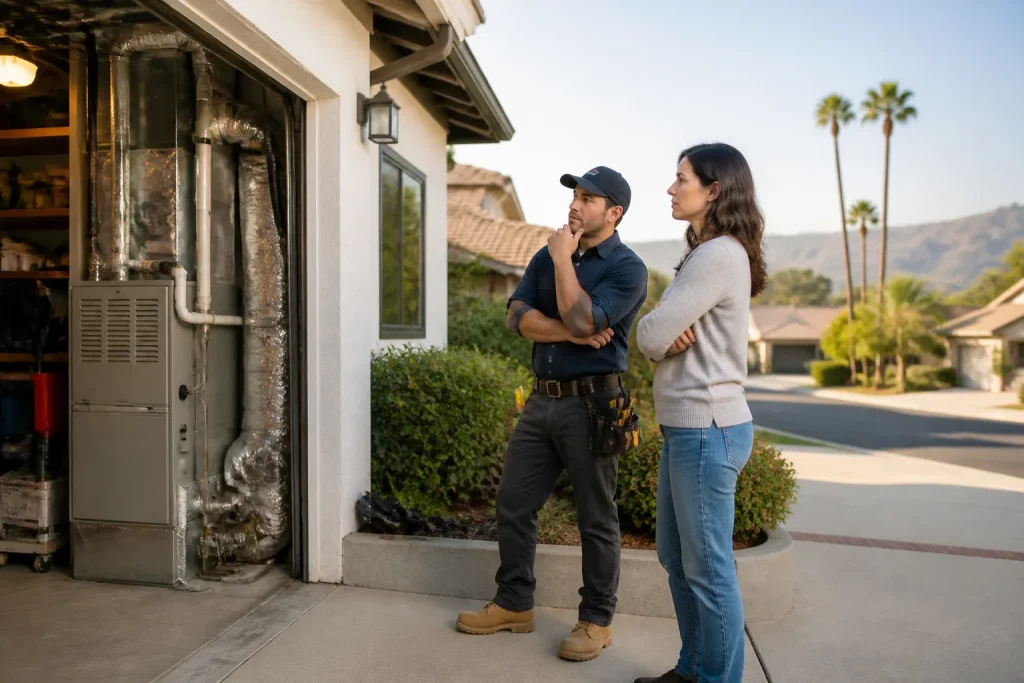
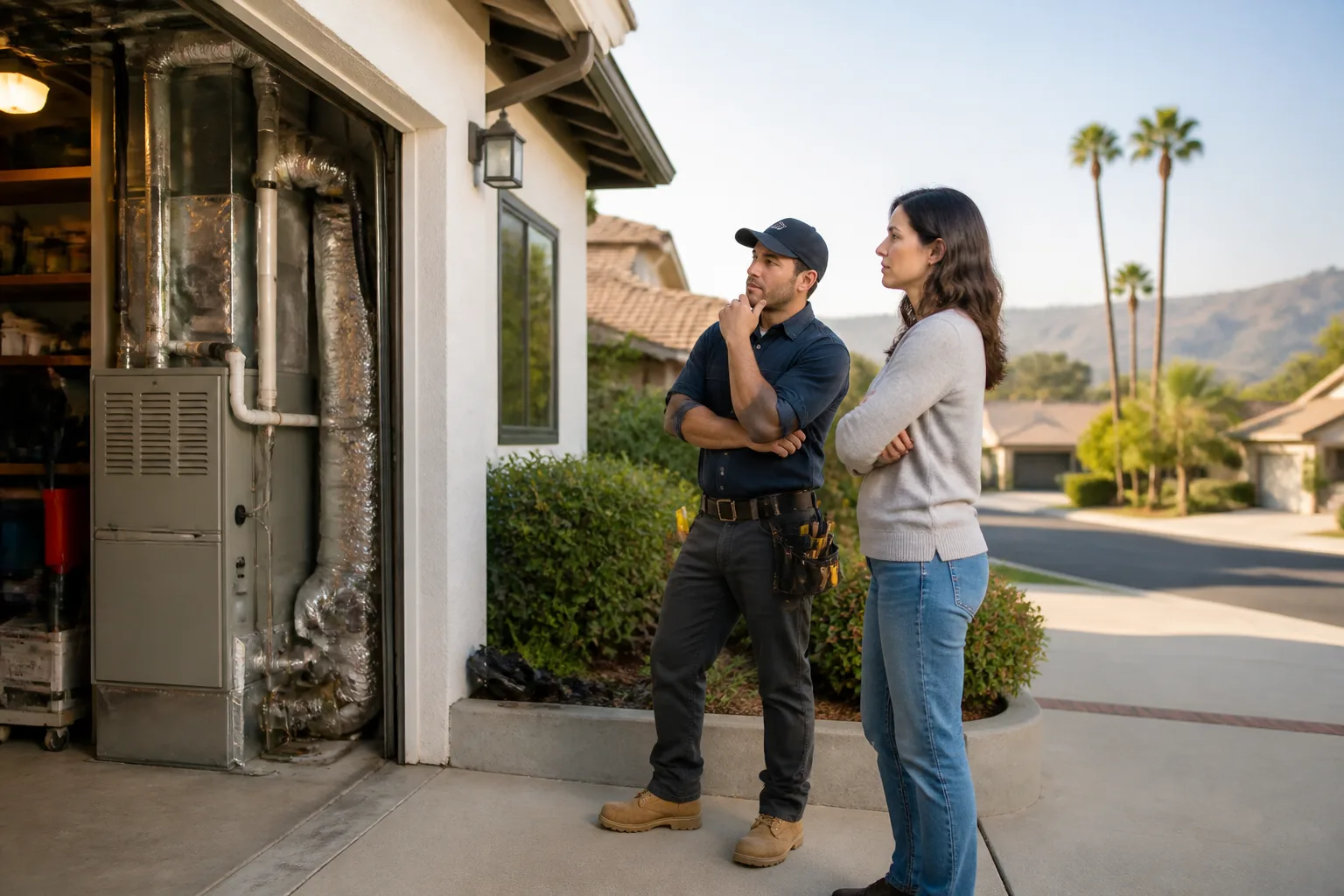
Heating & Furnace: Repair or Replace? How Los Angeles Homeowners Decide
Most Los Angeles homeowners should repair their furnace if it’s under 12 years old, the repair costs under $600, and the heat exchanger is intact. Replace it if the unit is 15+ years old, needs major heat exchanger work, or your repair bills are climbing past $1,500 in a single season. The catch? Los Angeles’s mild winters mean age alone is a poor guide — we’ve seen 18-year-old furnaces in Manhattan Beach that run half the hours of a 10-year-old system in Minneapolis.
If you’d rather not sort this out alone, call us at (877) 454-5066 for a free, no-pressure estimate. Anthony shows up on the job, not a sales rep.
Why Los Angeles’s Climate Changes the Math
Here’s what the national HVAC guides get wrong about our city. A furnace in Chicago might run 2,000 hours per heating season. In Los Angeles, even in a cooler pocket like the San Fernando Valley, you’re looking at maybe 400 to 600 hours. That means a 15-year-old Los Angeles furnace often has less actual wear than an 8-year-old system in a cold climate.
We learned this the hard way on a job in Pasadena about six years back. Homeowner insisted their 17-year-old Carrier was “ancient” and needed replacement. We inspected it, found clean burners, solid heat exchanger, one bad ignitor. $280 repair, and that unit ran another four seasons before they sold the house. They’d been quoted $4,200 for a new system by a company that never opened the cabinet.
The real metric is usage hours plus maintenance history, not the date on the nameplate. A furnace in Santa Monica with annual tune-ups and moderate use can outlast a neglected unit in Burbank that cycles on and off all winter fighting poor insulation.
So when we evaluate repair versus replace in Los Angeles, we ask: How many hours has this thing actually run? Has it been maintained? Is this the first problem, or the fourth in two years?
The Heat Exchanger: The Line You Don’t Cross
There’s one absolute in this decision: a cracked heat exchanger means replacement, full stop. No reputable technician in Los Angeles should patch, weld, or “monitor” a cracked exchanger. Here’s why.
The heat exchanger is the metal chamber that separates combustion gases from the air blowing into your home. When it cracks, carbon monoxide can leak into your supply air. CO is odorless, invisible, and potentially fatal. We’ve responded to emergency calls in Glendale and Inglewood where families were experiencing headaches and nausea — the furnace was running, the CO detector hadn’t triggered yet, and the exchanger was cracked in multiple spots.
Warning signs we check for:
- Soot buildup around furnace cabinet or registers
- Unusual odors when the blower starts
- Water pooling where it shouldn’t (secondary heat exchanger issues on condensing furnaces)
- Any mention of “weird smells” from the homeowner
In our 19 years, we’ve never repaired a cracked heat exchanger. The part alone often costs $1,200 to $2,000 on older units, and the labor to replace it approaches the cost of a new furnace. More importantly, no warranty covers the integrity of a field-replaced exchanger the way a factory-new unit is protected.
If you’re in Los Angeles and a technician suggests “fixing” a cracked heat exchanger, get a second opinion. Or call us — we’ll show you the camera footage.
Reading Your Burner Flame: A Diagnostic Before the Phone Call
Here’s something useful you can check yourself, safely, in about 30 seconds. Pull the inspection panel off your furnace (usually two thumb screws) and watch the burner flame while the unit runs.
A healthy flame: Steady blue with small yellow tips, centered on the burner.
A problem flame: Yellow, orange, or flickering; dancing away from the burner; rolling out toward the front of the cabinet.
A yellow or flickering flame usually means incomplete combustion. Causes range from simple (dirty burner, restricted air intake) to serious (cracked heat exchanger drawing excess air, improper gas pressure). We saw this last month in a Culver City garage where a homeowner’s Goodman had been “running fine” but the flame was nearly orange. Turned out the secondary heat exchanger was partially blocked. Caught early, repairable. Ignored, it would have destroyed the inducer motor and cost triple.
If you see a yellow flame, call for service. Don’t attempt burner adjustment yourself — gas pressure and air mixture require calibrated tools. But knowing what you’re looking at helps you describe the problem and speeds diagnosis.
Real Cost Comparison: Repairing the Old vs. Buying New
Los Angeles homeowners often ask us for the honest numbers. Here’s how we break it down on actual jobs.
| Scenario | Typical Cost | Efficiency | Annual Gas Use (Los Angeles avg.) |
|---|---|---|---|
| Repair 80% AFUE furnace (ignitor, limit switch, minor part) | $250–$650 | 80% AFUE | ~400 therms |
| Major repair 80% AFUE (blower motor, control board) | $800–$1,800 | 80% AFUE | ~400 therms |
| Replace with 95% AFUE single-stage | $3,800–$5,200 | 95% AFUE | ~340 therms |
| Replace with 96%+ AFUE variable-speed | $4,500–$6,500 | 96–98% AFUE | ~320 therms |
At current Southern California Gas rates, that efficiency jump saves roughly $80 to $150 per year in Los Angeles. The payback on a full replacement stretches to 15+ years if you’re only counting utility bills. But that’s not the whole picture.
Where replacement pays off faster: your time, your comfort, and your repair trajectory. A furnace needing $1,200 this winter and likely $800 next winter is a money pit. A new Rheem or York with a 10-year parts warranty and our install labor warranty — that’s predictable.
We work on your brand, whatever it is. But when replacement makes sense, we install Goodman, Rheem, York, and Daikin regularly, matched to the house and the homeowner’s actual heating load, not a commission target.
When We Repair the Older Unit Anyway
Despite everything above, there are times we actively recommend repair on a 15- or even 18-year-old furnace.
- Single component failure on a clean history: First bad ignitor in 14 years? Replace the ignitor. The rest of the system hasn’t proven itself unreliable.
- Excellent maintenance records: Annual filter changes, professional tune-ups, clean blower. These units wear slowly and predictably.
- Planned home sale within 2–3 years: A functional furnace passes inspection. A new furnace rarely returns its full cost in sale price.
- Tight budget with no safety issues: We’d rather see a safe, repaired 80% unit than a homeowner stretched thin on a premium system they don’t need.
Last year in West Adams, we repaired a 16-year-old Trane with a failed pressure switch. Homeowner was prepared to replace. We showed them the clean heat exchanger, the solid blower amp draw, the minimal rust. $340 repair, and we told them honestly: this could run three more years or seven. They’ll know when the pattern changes.
That’s the difference when the founder still shows up on the job. We’re not incentivized to sell you equipment you don’t need. Our 286 customers and counting come back because we tell them the truth.
When to Call a Pro
Call us if you’re seeing any of the following: repeated cycling (on-off-on-off in short bursts), rising gas bills without rate changes, uneven heating room-to-room, any mention of odors or headaches when the furnace runs, or a repair quote over $1,000 on a unit over 12 years old. We’ll inspect the heat exchanger with a camera, test gas pressure and combustion, and give you a straight recommendation with the reasoning behind it.
Related services in Los Angeles: We also handle Meridian Heating & Air Los Angeles home for all HVAC needs, plus AC Repair & Installation in Sacramento, Heating & Furnace in Sacramento, and Heat Pump & Mini Split in Sacramento for our Northern California customers.
The Bottom Line
Repair your Los Angeles furnace if it’s safe, the fix is under $600 to $800, and this isn’t the third problem in two years. Replace it if the heat exchanger is compromised, repair costs exceed 40% of replacement, or you’re facing a cascade of failures on an unmaintained unit. Ignore the calendar; count the hours, the history, and the safety checks.
At Meridian Heating & Air, we’ve guided Los Angeles homeowners through this decision for nearly two decades. Anthony shows up on the job, inspects your system personally, and explains what we’re seeing before any work starts. No hidden fees, no pressure to upgrade, no rotating crew of strangers.
Call (877) 454-5066 for a free estimate. We’ll give you the honest assessment you’d want from a neighbor who happens to know furnaces inside and out.
Frequently Asked Questions
Most common repairs run $250 to $650 for parts like ignitors, flame sensors, or limit switches. Blower motors and control boards push closer to $800 to $1,800 installed. We always diagnose first and quote upfront — call (877) 454-5066 for exact pricing on your system.
Repair is cheaper in the short term almost every time. Replacement becomes the smarter financial choice when cumulative repairs exceed $2,000 in two years, or when any single repair approaches 50% of a new system’s cost. In Los Angeles’s mild climate, that threshold is higher than in cold states because our furnaces accumulate fewer runtime hours.
With proper maintenance, 15 to 20 years is realistic in Los Angeles due to lower annual usage. Without maintenance, 10 to 12 years is more typical. The key variable isn’t time — it’s runtime hours plus how well the unit has been cared for.
We stock common parts for Goodman, Rheem, York, and other major brands, and we prioritize no-heat calls during cooler months. Same-day service is often available for standard repairs, though heat exchanger replacements require ordering and a return visit. Call (877) 454-5066 and we’ll tell you honestly what your timeline looks like.
Written by Anthony Moreno, Founder & Lead Installer at Meridian Heating & Air Los Angeles, serving Los Angeles since 2007.
Need HVAC Help?
Call Meridian Heating & Air Los Angeles — licensed & insured, here with fast after-hours help in Los Angeles.
(877) 454-5066