
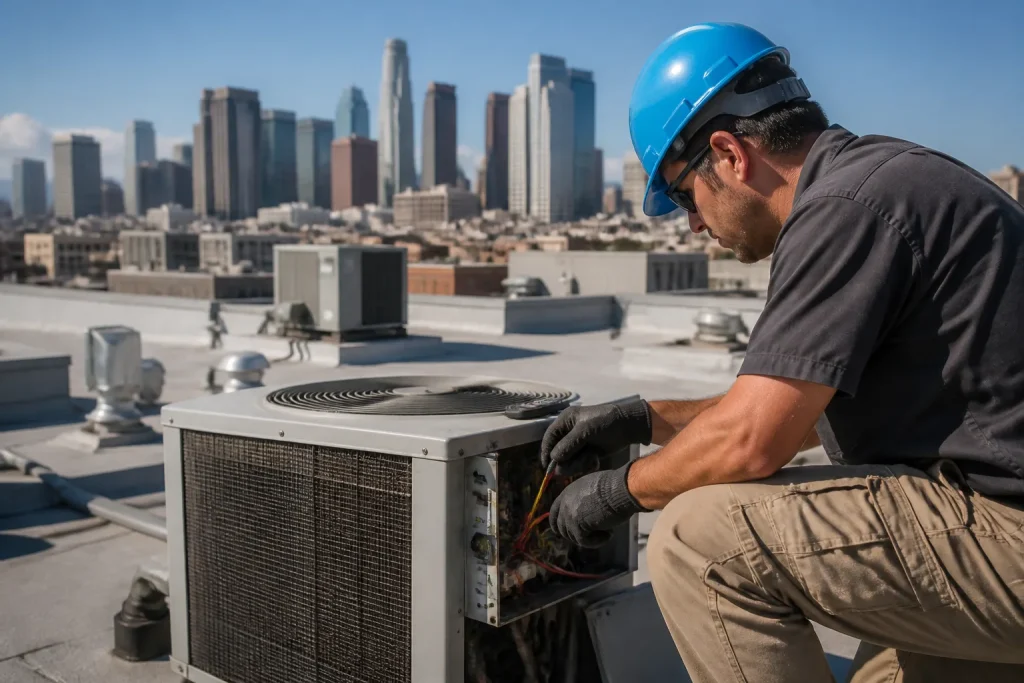
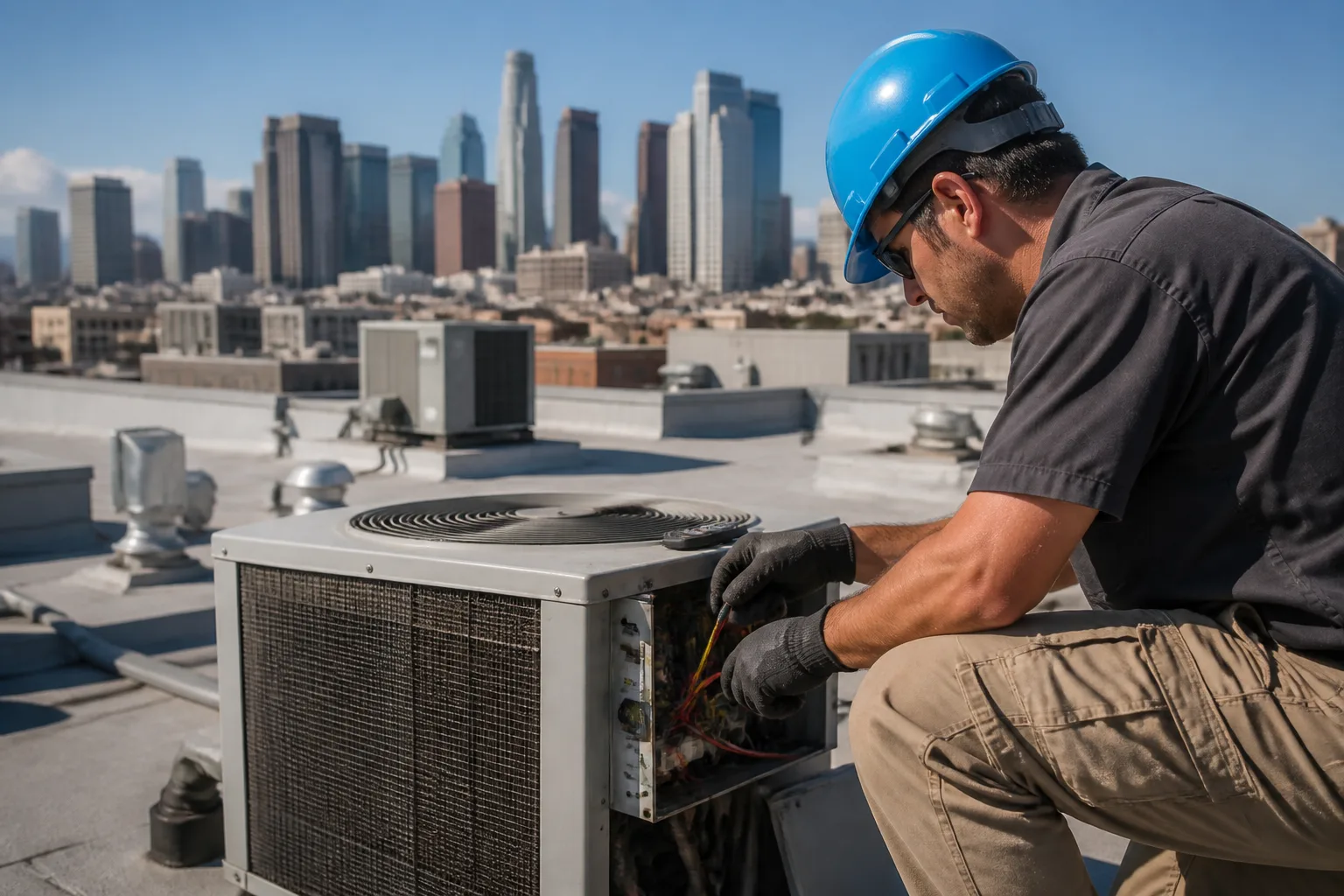
5 Mistakes to Avoid With Emergency & Commercial HVAC
Emergency commercial HVAC failures in Los Angeles typically cost 3–5 times more to fix overnight than during a planned service call, and nearly every one we’ve responded to could have been prevented by avoiding five common operational mistakes. The businesses that recover fastest aren’t the ones with the newest equipment; they’re the ones with the right preparation and the right partner already in place. If you’d rather not learn these lessons the hard way, call Meridian Heating & Air Los Angeles at (877) 454-5066.
Every commercial HVAC disaster I’ve walked into had a warning sign that got ignored: a thermostat that “ran a little warm,” a compressor that “cycled funny,” an error code the office manager photographed and never sent to anyone. After 19 years of emergency calls across Los Angeles, from downtown high-rises to warehouse districts in the San Fernando Valley, the pattern is unmistakable. The failures that shut businesses down aren’t usually technical mysteries. They’re organizational oversights that compound under pressure.
1. No Documented Equipment Inventory
This single omission doubles our response time on every emergency call where it happens, and it happens constantly.
When a rooftop unit fails at 2 a.m. in July, the technician needs three things immediately: equipment model number, age, and service history. Without them, we’re diagnosing blind. We can’t verify refrigerant type, check warranty status, or know whether that unit had a compressor replacement two summers ago. What should be a two-hour repair becomes a six-hour ordeal while we source parts we might have carried if we’d known what we were walking into.
We see this constantly in Los Angeles, especially in buildings that have changed property management companies or where the original installer has vanished. The maintenance closet has a folder of random receipts, maybe a business card from 2019, and a handwritten note that says “Unit on north side — broken again.”
Here’s what belongs in every equipment file:
- Manufacturer, model number, and serial number for every unit
- Installation date and any major repair dates
- Refrigerant type and charge history
- Last filter change and belt replacement
- Photos of nameplates and any modifications
Keep a digital copy and a physical copy. Update it after every service visit. The 20 minutes this takes will save you hours of downtime and hundreds in after-hours labor when something fails.
2. Using Residential Contractors for Commercial Equipment
This mistake usually starts with a frantic Google search at 11 p.m.: “emergency HVAC repair near me.” The first company that answers gets the call, and nobody checks whether they’ve ever touched a 20-ton rooftop package unit.
Commercial and residential HVAC share basic principles, but the execution diverges significantly. The refrigerant types differ — many commercial systems still run R-22 or specialized blends that residential techs rarely encounter. The control systems are more complex, with building automation integration, economizers, and multi-zone sequencing that residential thermostats don’t approach. Electrical requirements are heavier, and Los Angeles code enforcement for commercial installations is stricter, with specific seismic bracing and clearance rules that residential contractors often don’t know.
We’ve been called to fix the aftermath. A residential contractor who misdiagnosed a failed economizer controller on a Carrier rooftop unit in Commerce, spent six hours chasing the wrong problem, and left with the system running in manual override — functional enough to seem fixed, but burning 40% more energy and providing no outside air ventilation. The building owner found out when employees started complaining about headaches.
At Meridian, we work on nine major brands including Carrier, Daikin, and American Standard, and we’ve factory-trained on the commercial control systems that matter. Anthony shows up on the job, not a rotating subcontractor who might have seen two commercial units in his career.
3. Deferring Preventive Maintenance to Cut Costs
This is the most expensive “savings” decision a Los Angeles business owner can make, and we watch it backfire every summer.
Los Angeles rooftop units run through brutal heat cycles — 90°F ambient, direct sun on black membrane roofs that push surface temperatures past 140°F. The thermal stress is constant from June through October. Without preventive maintenance, specific failure modes become nearly predictable:
- Condenser coils clogged with urban dust and particulate — head pressure rises, compressor overheats, failure within 2–3 weeks of peak load
- Refrigerant leaks at vibration points — slow at first, then sudden loss of cooling during the hottest day of the year
- Belts worn to glazing — snap under load, taking out airflow and freezing the evaporator
- Drain pans rusted through — water intrusion into ductwork, mold, and ceiling damage that exceeds the cost of five years of maintenance
We pulled a unit out of a garage over in Vernon last month where the owner had skipped three years of service to “save money.” The condenser looked like it was packed with felt. Compressor was toast. The replacement cost what ten maintenance visits would have. He wasn’t wrong that maintenance costs money. He was wrong about what deferral actually costs.
Related services in Los Angeles: AC Repair & Installation in Sacramento | Heating & Furnace in Sacramento
4. The After-Hours Service Contract Mistake
Too many businesses sign with the cheapest emergency provider without verifying two critical details: commercial equipment certifications and guaranteed response windows.
The contract says “24/7 emergency service.” It doesn’t say “commercial-certified technician,” and it doesn’t say “on-site within 2 hours.” We’ve seen contracts where “emergency response” meant a dispatcher took the call and scheduled someone for the next business day. We’ve seen “commercial service” that meant the company had once installed a mini split in a dentist’s office.
Before you sign, ask directly:
- Is your after-hours technician commercial-certified for our equipment type?
- What’s your average on-site time for emergency calls in our area of Los Angeles?
- Do you stock parts for our brand and model, or are you ordering overnight?
- What’s the rate structure — flat emergency fee, or hourly with markup?
At Meridian Heating & Air, emergency HVAC service is part of our full-spectrum coverage. We’ve spent nearly two decades building relationships with parts suppliers across Los Angeles so we’re not waiting on overnight shipping when your system is down. But we still tell every client: verify this with whoever you choose. The wrong contract is worse than no contract, because it creates false confidence.
5. No Temporary Cooling Plan
This is the mistake that turns a manageable repair into a botched overnight fix that causes bigger problems.
When a commercial system fails completely, the pressure to restore cooling immediately is intense. Employees are uncomfortable, inventory is at risk, customers are complaining. Without a temporary cooling plan, business owners feel forced to accept whatever fix the technician can cobble together by morning — often a shortcut that violates warranty, reduces efficiency, or creates safety issues.
A proper temporary cooling plan buys time for correct diagnosis and repair. For most Los Angeles businesses, this means:
- Identifying portable cooling units available for rent on short notice — know the vendor and capacity requirements before you need them
- Understanding which zones can be temporarily closed or consolidated to reduce load on remaining equipment
- Having operational procedures for heat-sensitive inventory or equipment — what gets moved, what gets powered down, who decides
- Knowing your critical temperature thresholds and how long you can operate above them
We consulted with a medical office in Burbank that had this figured out. When their primary Bryant system failed on a Saturday, they deployed two portable units to server and medication storage areas, adjusted patient scheduling for cooler morning hours, and gave us the weekend to source the correct replacement compressor. Total disruption: minimal. Cost of the “emergency” repair: standard rates, no after-hours premium, no shortcut installation.
When to call a pro: If your commercial HVAC system is making unusual noises, cycling erratically, or showing error codes you don’t recognize, don’t wait for total failure. These are the warning signs we see before every emergency call. Addressing them during business hours costs a fraction of the overnight premium.
For heat pump and ductless solutions that might supplement your primary system, see Heat Pump & Mini Split in Sacramento.
The Bottom Line
The five mistakes that turn manageable commercial HVAC problems into extended crises are all preventable with preparation: document your equipment, hire qualified commercial technicians, maintain your systems proactively, verify your emergency contracts, and have a temporary cooling plan ready. None of these require technical expertise — they require organizational discipline and the right partner.
If you’re in Los Angeles and want to review your commercial HVAC preparedness, or if you’re facing an emergency and need experienced hands on-site, Meridian Heating & Air Los Angeles offers free estimates. Call (877) 454-5066. With 286 customers and counting and nearly two decades of hands-on HVAC experience, we’ll give you a straight assessment and a proper fix.
Frequently Asked Questions
Ask for specific commercial certifications and experience with your brand and system type. A qualified contractor can name the refrigerant your system uses, describe recent commercial jobs of similar scale, and explain Los Angeles code requirements for commercial installations without hesitation. If you’re unsure about your current contractor’s qualifications, call (877) 454-5066 — we’ll give you an honest second opinion.
Deferred maintenance on condenser coils and refrigerant systems, compounded by extreme rooftop heat exposure during summer months. Los Angeles buildings without regular preventive service typically experience compressor failures, refrigerant leaks, or electrical control failures during peak load periods in July through September.
It depends entirely on what’s actually guaranteed. A contract that only promises someone will answer the phone isn’t worth much. A contract with verified commercial technician availability, guaranteed response windows, and stocked parts for your specific equipment can prevent extended downtime that costs far more than the contract itself. Read the details carefully, or have us review it with you.
Yes, temporarily, if you plan ahead. Portable units work for critical zones like server rooms, medication storage, or small office areas, but they won’t cool a full commercial space efficiently. The key is knowing your vendor, required capacities, and deployment priorities before the failure happens. We help Los Angeles businesses build these plans during routine service visits.
Written by Anthony Moreno, Founder & Lead Installer at Meridian Heating & Air Los Angeles, serving Los Angeles since 2007.
Need HVAC Help?
Call Meridian Heating & Air Los Angeles — licensed & insured, here with fast after-hours help in Los Angeles.
(877) 454-5066