
5 Mistakes to Avoid With Heat Pump & Mini Split
The five biggest mini split mistakes Los Angeles homeowners make don’t happen at the store — they happen in the years after installation, during quiet neglect that degrades the system long before any obvious breakdown. Skipped filter cleanings, blocked outdoor units, and ignored error codes are the real culprits behind that July emergency call when the unit stops cooling entirely. If you’d rather not troubleshoot this yourself, Meridian Heating & Air Los Angeles offers free estimates — call (877) 454-5066.
We’ve been installing and servicing heat pumps and mini splits across Los Angeles for nearly two decades. Last week we pulled a condenser out of a garage over in Highland Park where the homeowner had stacked storage boxes within six inches of the unit for three years. The compressor finally gave out on a 102-degree day. The mistake wasn’t buying the wrong system. It was never giving the installed unit room to breathe.
1. Running Your Mini Split in “AUTO” Mode Year-Round
Los Angeles has a peculiar climate — dry summers, mild winters, and those Santa Ana swings that can shift your indoor temperature 15 degrees in an afternoon. The “AUTO” setting on your mini split remote seems logical. Set it and forget it. In our experience, it’s the single most common setting we disable when we service units in Echo Park, Culver City, and the Valley.
Here’s what AUTO actually does: it toggles between heating and cooling based on a narrow temperature band around your setpoint. In October, when your Los Angeles home might hit 78 degrees by 3 p.m. and drop to 68 by evening, AUTO will switch the unit from cooling to heating and back again — sometimes multiple times per day. Each switchover wastes energy. More critically, it forces the reversing valve to cycle constantly, a component that fails expensively and almost always outside warranty because manufacturers classify this as operational stress, not defect.
We tell customers: pick a mode and stay there. Cooling from April through October, heating from November through March. Los Angeles rarely needs both in a single day if you manage your windows and shading. For the few odd weeks when mornings are cool and afternoons warm, use “DRY” mode or a ceiling fan rather than forcing the system to hunt between functions.
Brands like Carrier and Trane engineer their mini splits for stable operation, not mode-hopping. We’ve replaced prematurely failed reversing valves on seven-year-old Daikin units that should have lasted fifteen. Every one was run on AUTO through multiple Los Angeles shoulder seasons.
2. Choking the Outdoor Unit With Landscaping and Fencing
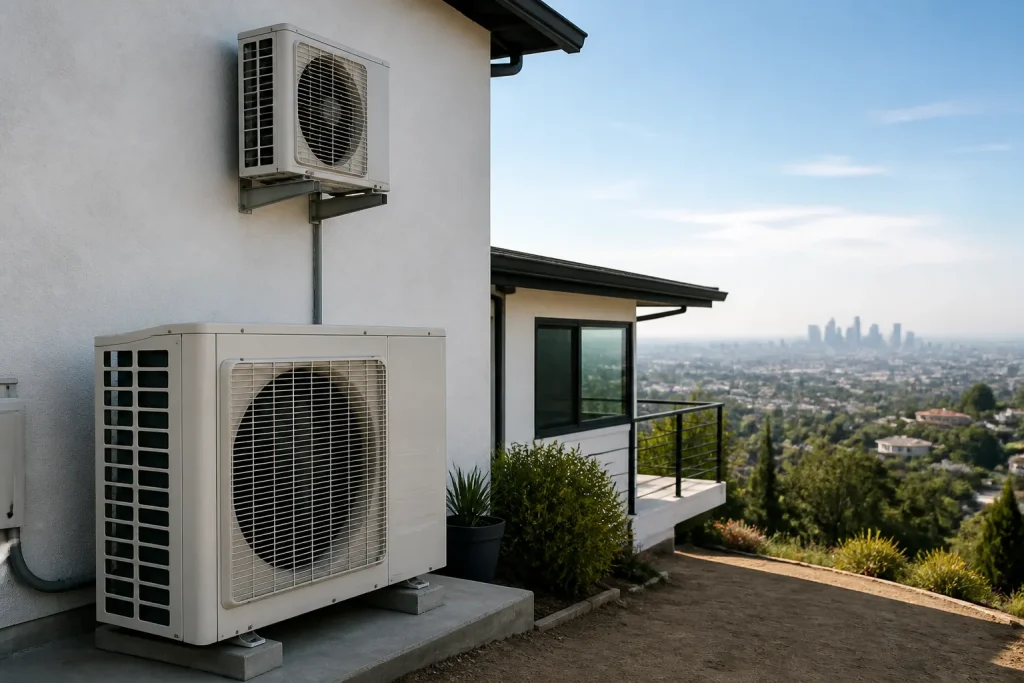
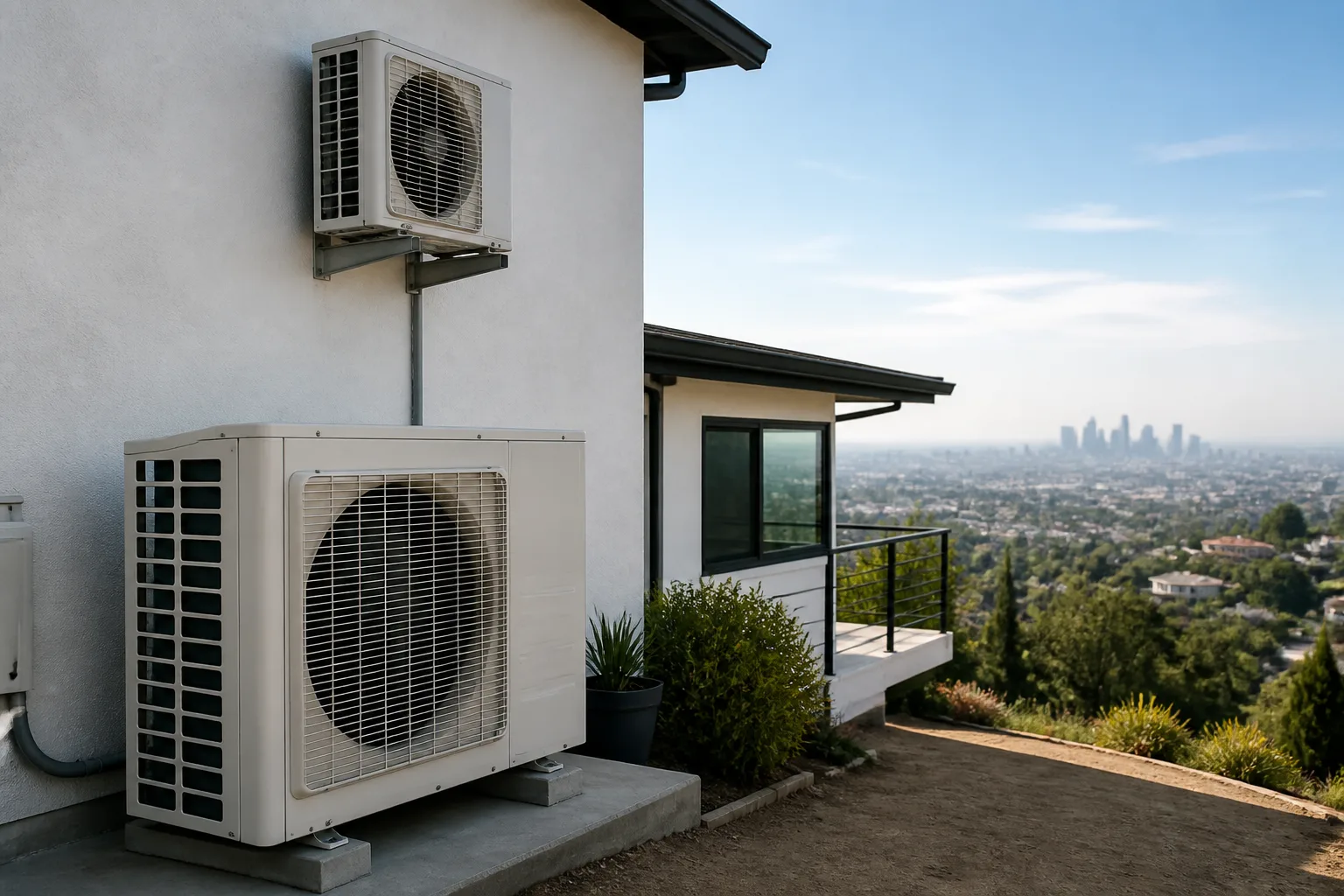
Los Angeles homeowners love their outdoor spaces. We get it. But we’ve lost count of how many condensing units we’ve found walled in by decorative lattice, surrounded by bird of paradise plants, or tucked into side yards with six inches of clearance on three sides. Your outdoor unit is an air-breathing machine. When it can’t exhale, it can’t inhale either. Head pressure climbs. Efficiency drops. The compressor works harder and dies younger.
Every manufacturer specifies clearance: typically 12 inches minimum on sides, 24 inches on the service access panel, and 60 inches overhead. In practice, we recommend more in Los Angeles. Our summers run long and hot. That unit needs every cubic foot of airflow it can get when it’s 95 degrees in September and your system has been running since June.
The specific mistake we see in Los Angeles: homeowners install privacy screens or plant hedges for aesthetic reasons, planning to “trim them back.” Three years later, the ficus has swallowed the unit. We serviced a Trane system in Los Feliz last month where the homeowner had built a custom cedar enclosure with louvered vents. Looked beautiful. Reduced airflow by 40 percent. The compressor was drawing 23 percent over rated amperage and had already tripped the internal overload twice.
Keep it simple. Gravel base, level pad, nothing within 18 inches that grows or blocks. If you must screen it, use manufacturer-approved clearance dimensions and leave the service side completely open. We work on your brand — whether it’s Goodman, Lennox, or any of the nine major lines we service — and every single one needs air.
3. Attempting DIY Refrigerant “Top-Offs” From Online Tutorials
This one makes us wince. YouTube has convinced a generation of Los Angeles homeowners that refrigerant is like oil in a car — it gets used up and needs periodic topping off. It doesn’t. Mini splits and heat pumps are sealed systems. If the charge is low, you have a leak. Full stop.
The DIY kits sold online use propane-based “stop leak” blends or incorrect refrigerant types. R-410A and the newer R-32 require precise superheat and subcooling measurements, digital manifold gauges, and recovery equipment. More critically, introducing unapproved refrigerant or sealant voids your warranty immediately. We’ve had customers in South Gate and Torrance present us with units where the compressor failed after a DIY charge, and the manufacturer denied coverage based on contaminated refrigerant analysis.
Here’s what a proper refrigerant service looks like: nitrogen pressure test to locate the leak, electronic leak detection, repair or replace the affected component, deep vacuum to remove moisture and non-condensables, and weighed-in charge to the gram using the manufacturer’s data plate. Takes specialized equipment and training. Anthony shows up on the job with the right tools — it’s not a job for a can from the auto parts store.
The real danger isn’t just voided warranty. Masking a leak with stop-leak can clog the metering device or damage the compressor. We’ve replaced systems at eight years that should have lasted twenty, all because a slow leak went unaddressed while someone kept adding refrigerant.
4. Following the Manual’s Generic Filter Schedule in LA’s Air
Your mini split manual probably says “clean filters every six months.” That recommendation was written for moderate climates with average particulate levels. Los Angeles is not moderate, and our air quality is not average.
Between freeway proximity, construction dust, seasonal wildfire smoke, and the fine particulate that blows in from the desert, Los Angeles indoor air loads filters faster than almost any major U.S. city. We tell our customers: check monthly, clean every six to eight weeks during high-use months, and replace disposable media filters quarterly if your system uses them.
The washable mesh filters in most mini splits trap surprisingly fine particles. When they’re dirty, airflow drops, coil temperature falls, and the unit ices up. In heating mode, restricted airflow overheats the coil and trips high-limit safeties. We’ve responded to “no heat” calls in January where the only problem was a filter so clogged it could have been used as insulation.
Cleaning is simple enough — warm water, mild detergent, full dry before reinstalling. But the schedule matters more than the method. During the 2020 wildfire season, we were cleaning filters for repeat customers in Pasadena every three weeks. The units were working fine; the air was just that loaded. From routine tune-ups to emergency calls, we’ve learned that filter discipline in Los Angeles prevents about 30 percent of the service calls we otherwise receive.
5. Ignoring the Condensate Drain Because “It Never Floods Here”
Los Angeles is dry. Our annual rainfall is barely twelve inches. So homeowners skip the condensate drain check — why worry about drainage in a drought?
Because your mini split produces condensate from humidity removal, not rainfall. And because that rare heavy rain season, when it comes, finds drains already clogged with dust, pollen, and the biofilm that grows in stagnant trap water. We’ve seen ceiling damage in Santa Monica condos and Burbank bungalows from backed-up condensate that had nothing to do with rain and everything to do with two years of unchecked sludge.
The drain line runs from your indoor evaporator to an exterior termination point, usually with a P-trap to prevent sewer gas backdraft. In cooling mode, that line carries water continuously during operation. Algae and bacterial growth narrow the bore over time. A single colony can reduce flow enough that the drain pan overflows during a long cooling day.
Annual flushing with proper cleaner, not bleach (which corrodes fittings and degrades PVC), takes ten minutes during a maintenance visit. We check the trap prime, verify the termination isn’t blocked by spider webs or landscaping, and confirm the safety float switch actually works. That switch is your last defense — when it fails, water goes somewhere expensive.
Los Angeles may not flood often. But when your mini split does, it’s always during the August heat wave when every HVAC company in the city is booked solid.
When to Call a Pro
If you’re seeing error codes, hearing unusual compressor noise, or noticing reduced airflow from any head unit, the system is telling you something. Early intervention on mini splits is almost always cheaper than emergency replacement. Heat Pump & Mini Split in Sacramento is our dedicated service page for system specifics, though we handle Los Angeles calls directly at (877) 454-5066.
Related services in Los Angeles: AC Repair & Installation in Sacramento and Heating & Furnace in Sacramento cover our full range for customers with mixed system types or older equipment due for upgrade.
The Bottom Line
The mini splits that last fifteen to twenty years in Los Angeles aren’t luckier than the ones that fail at eight. They’re simply given room to breathe, run in the right mode, kept clean on a realistic schedule, and serviced by people who know that “sealed system” means sealed, and “annual maintenance” means annually, not when something breaks.
At Meridian Heating & Air Los Angeles, we’ve installed and serviced heat pumps and mini splits from nearly every major manufacturer through nineteen years of Los Angeles summers. Our 286 customers and counting have left us with a 4.8-star average because we treat the quiet maintenance years with the same attention as the emergency calls.
If you’re in Los Angeles and want your system checked before the next heat wave, or if you’ve already noticed one of these mistakes catching up with you, call (877) 454-5066 for a free estimate. Anthony Moreno handles the assessment personally — no rotating subcontractors, no upsell pressure, just nearly two decades of hands-on HVAC experience applied to your specific setup.
Frequently Asked Questions
Every six to eight weeks during heavy-use months, and monthly during wildfire season or if you live near major freeways. The “every six months” in your manual assumes moderate air quality, not Los Angeles particulate loads. Check visually — if the mesh looks dusty, clean it. Call (877) 454-5066 if you’re unsure about your filter type or cleaning method.
Restricted airflow from dirty filters is the most common cause in Los Angeles homes. Low refrigerant from an undetected leak is second. Both reduce coil temperature below freezing, causing condensation to ice rather than drain. Turn the unit off, check and clean the filter, and call for service if icing recurs — running it frozen can damage the compressor.
Technically yes, but we don’t recommend it for Los Angeles. The frequent heating-cooling switching strains the reversing valve and wastes energy in our variable shoulder seasons. Use COOL or HEAT seasonally, and DRY or FAN for mild in-between weeks. We’ve replaced too many prematurely failed reversing valves on AUTO-run units to consider it harmless.
Measure 18 inches on all sides, 24 inches on the service access panel, and ensure nothing overhead blocks exhaust air. In Los Angeles, where summer runs long, more clearance is better. If shrubs, fences, or storage have encroached over time, clear them back. Reduced airflow shows up first as higher electric bills, later as compressor failure.
Written by Anthony Moreno, Founder & Lead Installer at Meridian Heating & Air Los Angeles, serving Los Angeles since 2007.
Need HVAC Help?
Call Meridian Heating & Air Los Angeles — licensed & insured, here with fast after-hours help in Los Angeles.
(877) 454-5066