
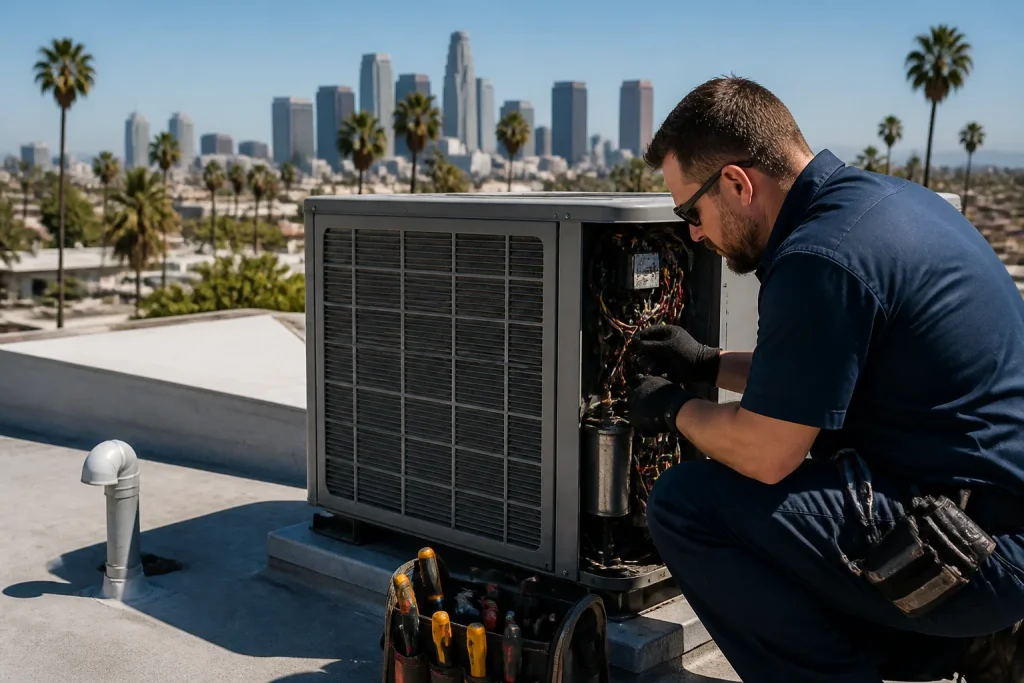
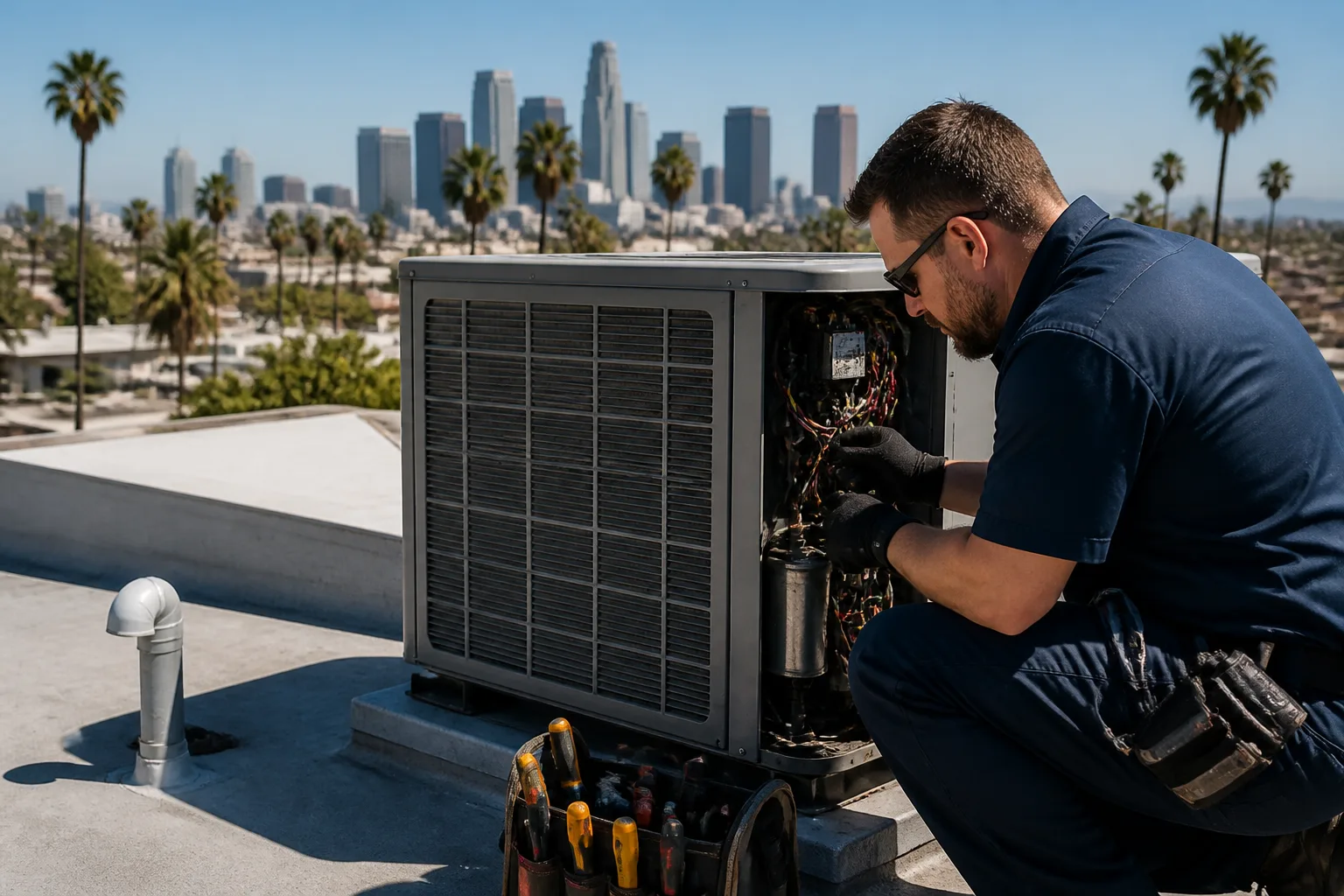
Air Quality & Ventilation: Repair or Replace? How Los Angeles Homeowners Decide
Most Los Angeles homeowners should repair their ventilation system if it’s under 12 years old and still moves within 15% of its designed CFM, but replace it if the unit predates 2013 efficiency standards or cannot be upgraded to meet current ASHRAE 62.2 minimums after wildfire smoke exposure has degraded the components. The decision hinges on measurable airflow performance, not how the system looks or whether it runs at all. If you’d rather not crawl into your attic with an anemometer, call us at (877) 454-5066 and we’ll test it properly.
Here’s what I’ve learned after 19 years: a homeowner will call me for an emergency when their AC dies on a 102-degree day in the San Fernando Valley. Nobody calls me for an emergency when their ERV has been moving 40% less air than designed for two years straight. The health impact and energy waste are just as real, but ventilation failure is silent. By the time you notice stuffy rooms, persistent dust, or rising energy bills, you’ve often missed the window where repair was the smarter financial call.
How to Actually Measure Whether Your Ventilation Is Working
Every ventilation system in Los Angeles has a design CFM, or cubic feet per minute, stamped on the unit or in the original permit paperwork. For homes built under Title 24, that’s typically 7.5 CFM per bedroom plus 7.5 CFM, or roughly 75–150 CFM for most single-family homes I see in neighborhoods like Eagle Rock, Mar Vista, and Northridge.
The problem is almost no homeowner knows their actual measured airflow. Here’s what we check on every ventilation assessment:
- Supply and exhaust flow at each register using a calibrated anemometer. We add up the readings and compare to design specs.
- Static pressure across the filter and coil. A filter loaded with wildfire particulate can double the pressure drop, which quietly strangles airflow.
- Duct leakage percentage. Title 24 now requires 6% or less leakage to outside. Pre-2019 systems often leak 15–25%.
- Runtime versus occupancy. An ERV running on a timer rather than a demand-controlled sensor is probably over-ventilating some hours and under-ventilating others.
If your measured total airflow is within 15% of design and your duct leakage is under 10%, repair is usually viable. We’ve brought 10-year-old York and Rheem ventilation units back to spec with targeted duct sealing, filter housing upgrades, and damper adjustments. But if you’re at 50% of design CFM with 20% duct leakage, throwing parts at the air handler is like patching a tire with a cracked rim.
When Duct Sealing Solves It Versus When Equipment Needs Replacement
This is where Los Angeles homeowners lose money. They replace a perfectly good ERV because the rooms feel stale, when the real culprit is flex duct that has pulled loose in a 140-degree attic or mastic that has dried and cracked after a decade of thermal cycling.
Duct sealing alone typically fixes the problem when:
- Airflow is low but the fan motor amp draw is normal, meaning the unit is trying but the air is escaping.
- Rooms farthest from the unit have the weakest flow, a classic pressure-loss pattern.
- Your energy bills spiked after a roof or rodent incident that could have damaged ductwork.
- The ventilation unit itself is under 10 years old and was properly sized originally.
Equipment replacement makes more sense when:
- The air handler motor is drawing high amps, running hot, or cycling on thermal overload.
- The heat exchanger core in an ERV is cracked or corroded, which we see after years of Santa Ana wind dust infiltration.
- The unit cannot accept MERV-13 or better filtration, which has become the practical minimum for Los Angeles since the 2017–2025 wildfire seasons.
- Original installation predates 2013 and lacks the efficiency features that now pay back in 4–6 years through reduced runtime.
Last month we were over in Highland Park where a homeowner had been quoted $3,800 for a full ERV replacement. We found 18 feet of disconnected return duct in the crawl space. Sealed it for a fraction of that, and their measured airflow jumped from 62 CFM to 118 CFM. That’s the difference between guessing and measuring.
How Wildfire Smoke Changed the Math on Filtration and Replacement
Los Angeles air quality events aren’t occasional anymore. Since the 2017 Thomas Fire, I’ve watched filter media life get cut in half during heavy smoke months. A MERV-8 pleated filter that lasted 90 days in 2015 now loads up in 45 days during September through November.
This matters for the repair-or-replace decision in two ways. First, older ventilation systems often have filter housings too shallow for MERV-13 cartridges. You can wedge one in, but the pressure drop spikes and airflow collapses. Second, the accumulated fine particulate from repeated smoke events coats fan blades, heat exchanger cores, and duct interiors in ways that basic cleaning can’t fully reverse.
If your system was designed around MERV-8 filtration and you now need MERV-13 for household health, check whether the existing unit can handle the load. Some Bryant and Daikin ERVs from the mid-2010s have upgradeable filter racks. Others need a motor upgrade or full replacement to avoid burning out the fan. We test this in the field, not from a catalog.
The financial reality: replacing a $200 filter twice as often costs $400/year. Upgrading to a system with a larger filter surface area and lower pressure drop pays for itself in filter longevity alone, before you count the health and energy benefits.
ERV Versus HRV: Why Most Internet Advice Doesn’t Apply to Los Angeles
Search “ERV or HRV” and you’ll find endless articles written for Minneapolis or Seattle. They obsess over winter humidity recovery. In Los Angeles, that’s irrelevant. Our design conditions are dry summers, mild winters, and the occasional humid Santa Ana pattern that lasts three days.
For Los Angeles specifically:
- ERVs recover both heat and moisture, which helps in summer when your air conditioner is fighting imported humid air, and in winter when indoor humidity can drop below 30%.
- HRVs recover only heat, making them slightly more efficient in pure temperature terms but useless for the moisture balance that affects comfort and mold risk.
- Replacement decision: if you have an HRV in Los Angeles, we almost always recommend upgrading to an ERV on replacement. The energy penalty is 3–5% and the comfort gain is substantial.
The exception is homes with existing humidity problems, like certain canyon-adjacent properties in Topanga or Malibu where summer fog penetration keeps indoor moisture elevated. Even then, we’d typically add dedicated dehumidification rather than stick with an HRV.
When we quote replacement, we size for actual Los Angeles conditions, not generic California climate zones. A system spec’d for Sacramento or Fresno will underperform here.
The One Question That Decides Repair or Replace
After 286 jobs and counting, I’ve boiled it down to this: can the repaired system meet current ASHRAE 62.2 minimums?
ASHRAE 62.2-2022 is the ventilation standard that Los Angeles building departments reference for permits and compliance. It specifies minimum whole-house and local exhaust rates based on square footage and bedrooms. It’s not theoretical; it’s what a home needs for acceptable indoor air quality.
Here’s how we apply it:
- We calculate your home’s ASHRAE 62.2 minimum requirement. A 1,800 square foot, 3-bedroom home in Silver Lake needs roughly 82.5 CFM of continuous whole-house ventilation.
- We measure your existing system’s actual delivered CFM after accounting for duct leakage.
- If repair can close that gap to within 10%, we repair. If the gap is 25% or more, replacement is the only code-compliant path.
This cuts through all the marketing. A 15-year-old ERV with a new motor might run quietly and blow air, but if it’s delivering 55 CFM against an 82 CFM requirement, you’re not ventilating. You’re circulating. And circulating stale air is what leads to the complaints we hear six months later: headaches, dust accumulation, condensation on windows.
When to call a pro: if you don’t know your system’s design CFM, its install date, or the last time filter pressure drop was measured, you’re flying blind. We’ve got the tools to answer the ASHRAE question in about 45 minutes.
Related services in Los Angeles: Meridian Heating & Air Los Angeles home for full HVAC assessment, or explore our AC Repair & Installation in Sacramento, Heating & Furnace in Sacramento, and Heat Pump & Mini Split in Sacramento for regional coverage.
The Bottom Line
Repair your Los Angeles ventilation system if measured airflow is within 15% of design, duct leakage is under 10%, and the unit can accept MERV-13 filtration without choking. Replace it if the system predates 2013, cannot meet ASHRAE 62.2 minimums after repair, or has sustained component damage from years of wildfire particulate loading.
The key is testing before deciding. Too many homeowners replace equipment that needed sealing, or seal ducts on equipment that was already beyond recovery. After nearly two decades of hands-on HVAC experience, I can tell you the difference usually shows up in 30 minutes with the right instruments.
If you’re in Los Angeles and want your ventilation system measured properly, Meridian Heating & Air offers free estimates. Anthony shows up on the job, not a rotating subcontractor. Call (877) 454-5066 and we’ll give you numbers you can act on.
Frequently Asked Questions
Repair typically runs $350–$1,200 for duct sealing, filter housing upgrades, or motor replacement on accessible units. Full ERV or HRV replacement in Los Angeles generally costs $2,800–$5,500 depending on home size, attic access, and whether electrical or duct modifications are needed. Call (877) 454-5066 for an exact quote — estimates are free.
Check monthly during September through November and replace when pressure drop exceeds manufacturer spec, which often means every 30–45 days during heavy smoke events versus 90 days in cleaner months. We work on your brand, whether that’s a Rheem, York, Daikin, Bryant, or another major system, and we stock the right MERV-rated replacements.
Only if the filter housing depth and fan motor can handle the increased pressure drop. Forcing a MERV-13 into a system designed for MERV-8 often collapses airflow and burns out the motor. We test static pressure before recommending any filter upgrade.
For homes with air conditioning, yes. An ERV pre-cools incoming ventilation air using exhaust air, reducing AC runtime by 10–20% in peak summer. In Los Angeles’s cooling-dominated climate, that payback period is typically 5–7 years, faster if you factor in filter longevity from the larger filter surface area most ERVs provide.
Written by Anthony Moreno, Founder & Lead Installer at Meridian Heating & Air Los Angeles, serving Los Angeles since 2007.
Need HVAC Help?
Call Meridian Heating & Air Los Angeles — licensed & insured, here with fast after-hours help in Los Angeles.
(877) 454-5066