
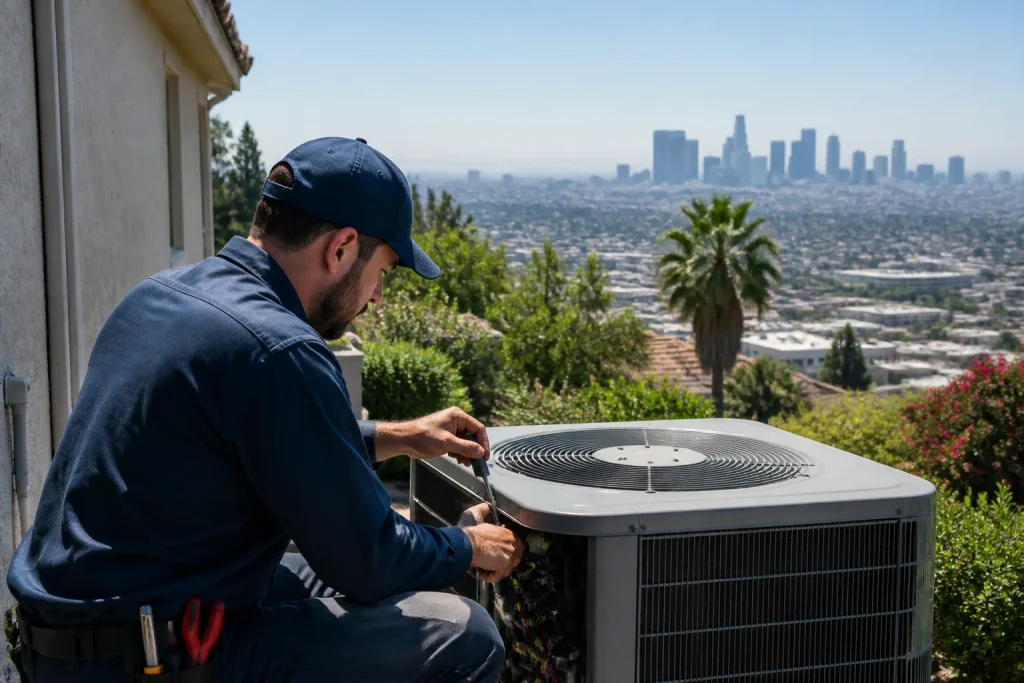
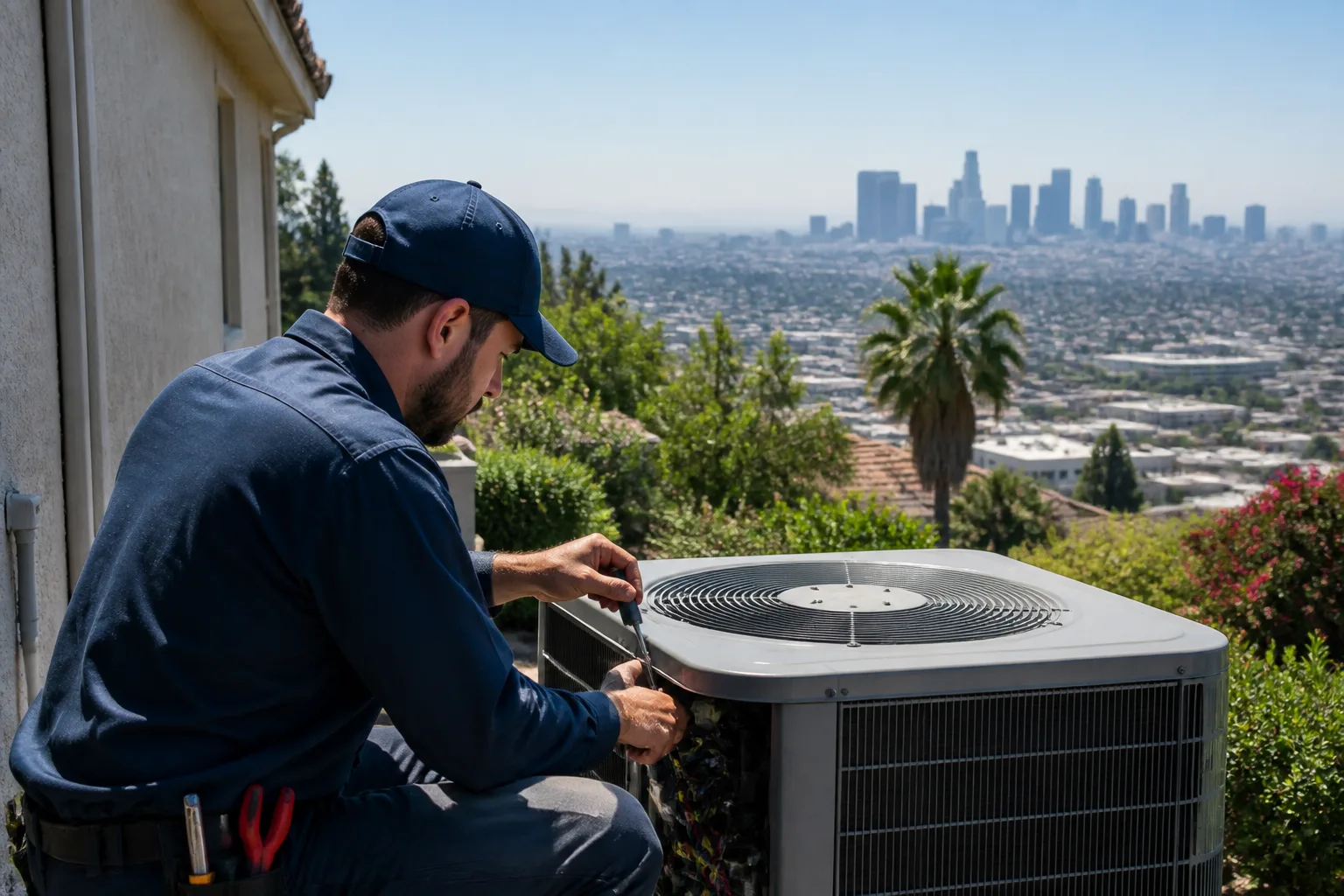
American Standard AC Repair & Installation in Los Angeles: A Homeowner’s Guide
American Standard AC repair in Los Angeles typically runs $180–$650 depending on the component, and a full system installation averages $5,500–$9,500 for the equipment sizes common in Southern California homes. Because American Standard shares its core platform with Trane, parts availability is generally strong, but that only helps if your technician understands the shared engineering. If you’d rather not sort this out yourself, call Meridian Heating & Air Los Angeles at (877) 454-5066 for a free estimate.
Here’s something most homeowners don’t realize: American Standard and Trane aren’t just owned by the same parent company. They share the same compressors, the same coil designs, and the same parts catalog. We pulled a failed contactor out of an American Standard unit in Van Nuys last month and the replacement box said Trane on it. The homeowner was confused. We explained that this is actually good news for long-term serviceability, but only if your tech knows to look for Trane-branded parts when American Standard inventory runs low. That single detail can mean the difference between a same-day fix and a three-day wait in August heat.
Why American Standard and Trane Share More Than a Logo
Ingersoll Rand owns both brands, and the manufacturing overlap runs deep. The AccuComfort variable-speed systems, the Spine Fin coil design, the Climatuff compressors — these are identical across both product lines. For Los Angeles homeowners, this matters in three concrete ways.
First, parts availability. When a distributor is out of American Standard inventory, Trane equivalents fit without modification. We’ve sourced Trane TXVs for American Standard evaporators in Burbank during peak summer when the American Standard shelf was bare. A technician who doesn’t know this relationship might tell you a part is backordered when it’s sitting in the next warehouse over under a different label.
Second, repair pricing stays competitive. Shared platforms mean shared economies of scale. You’re not paying premium prices for proprietary components the way you might with some European or niche Asian brands.
Third, technician training transfers directly. A tech qualified on Trane variable-speed communicating systems is qualified on American Standard’s equivalent. But here’s the catch: not every tech who claims brand familiarity actually has it. We’ve seen contractors in the San Fernando Valley advertise “all brands serviced” while their van carries only universal capacitors and contactors. American Standard’s communicating systems require specific diagnostic tools and protocol knowledge. Ask directly: “Have you worked on AccuComfort or Trane XV systems?” If they hesitate, keep looking.
Common American Standard Failures in Los Angeles Heat
Southern California’s climate creates specific stress patterns on American Standard equipment. After nearly two decades of calls across Los Angeles County, we’ve identified the failure points that show up repeatedly.
- Compressor overload in extended 95°F+ runs. American Standard’s Climatuff compressors are reliable, but the single-stage units in older homes work hard during Pasadena’s September heat waves. Capacitor degradation accelerates when run cycles stretch past 45 minutes repeatedly. We replace more start capacitors in late August than any other month.
- Refrigerant leaks at the Spine Fin coil base. The aluminum Spine Fin design transfers heat efficiently, but the coil-to-manifold joints can develop micro-leaks after 8–12 years. In coastal areas like Santa Monica, salt air corrosion compounds this. Leak detection takes time — a proper electronic scan, not just a bubble test.
- Variable-speed board failures from power fluctuations. Los Angeles grid stability varies by neighborhood. We’ve replaced more inverter control boards in Granada Hills and parts of the Valley after transformer events than in more stable grid areas. A whole-home surge protector helps, but many homes don’t have one.
- Drain line clogs from algae and hard water. The condensate pan design on some American Standard horizontal units can trap sediment. In areas with harder water like parts of the San Gabriel Valley, this means annual cleaning isn’t optional — it’s preventive maintenance that avoids ceiling damage.
One real example: a homeowner in Northridge called us in July with intermittent cooling. The previous company had charged the system twice in two years. We found a Spine Fin leak so small it only showed under 350 PSI nitrogen pressure. Patch, proper vacuum, weighed charge, and it’s held for three seasons now. Quick fixes hide problems. Proper diagnosis solves them.
What American Standard Warranty Coverage Actually Means
American Standard’s warranty structure is tiered, and the tier depends on who installs it. This is where many Los Angeles homeowners get caught off guard.
Base equipment warranty from the factory covers parts for 10 years on most units, but only if registered within 60 days of installation. Unregistered, it drops to 5 years. We’ve seen homeowners assume they’re covered at year 7 and learn otherwise.
The bigger variable is the dealer tier. American Standard ranks its installing contractors as Base, Silver, Gold, or Platinum. Higher tiers can offer extended warranties, labor coverage, and satisfaction guarantees that Base dealers cannot. A Platinum dealer’s installation comes with backing that a Base dealer simply can’t match.
Here’s what to verify before you sign:
- Is the installing dealer an authorized American Standard dealer, or just a contractor who can source the equipment?
- What tier is the dealer? Ask directly. They know.
- Does the quoted price include extended labor warranty, or is that separate?
- Who handles warranty claims — the dealer, or are you calling American Standard directly?
At Meridian Heating & Air Los Angeles, we handle warranty processing for our installations. You shouldn’t be navigating manufacturer phone trees when your AC fails in a heat wave.
Why Installation Quality Matters More for American Standard
American Standard’s higher-efficiency equipment is unforgiving of sloppy installation. Variable-speed compressors and communicating thermostats require precise refrigerant charge, correct airflow, and proper duct matching. A 20-SEER unit installed with leaky ducts performs like a 14-SEER unit and dies young.
We’ve replaced American Standard systems in Los Angeles that failed at 7 years because the original installer oversized the equipment, short-cycled it, and never set the dip switches for the communicating thermostat. The homeowner paid premium prices for premium equipment and got premium disappointment.
A proper American Standard installation in Los Angeles should include:
- Manual J load calculation — not rule-of-thumb sizing based on square footage alone. Los Angeles has microclimates. A home in Woodland Hills needs different capacity than the same footprint in Marina del Rey.
- Duct pressure test and sealing. New equipment on old leaky ducts is wasted money.
- Refrigerant charge by weight, not pressure readings alone. Subcooling and superheat verification.
- Thermostat commissioning with all features activated. The AccuLink communicating system only delivers its efficiency promises when properly configured.
- Written startup report with pressures, temperatures, and airflow documented.
We provide this on every installation. Anthony shows up on the job to verify it personally. That’s the difference between a system that hits its rated efficiency and one that doesn’t.
Red Flags: Spotting Technicians Who Don’t Know American Standard
Every summer, we get calls from Los Angeles homeowners who’ve already had one or two techs out. The system still isn’t right. Here are the warning signs we hear about most.
A technician who calls it “Ameri-Can Standard” — small thing, but if they haven’t bothered to learn the brand name, what else haven’t they learned?
Anyone who wants to replace a variable-speed board without first checking the low-voltage wiring and sensor inputs. These boards are expensive. A $12 sensor or a pinched low-voltage wire is the real culprit half the time we’ve been called for “board replacement” second opinions.
Quotes that don’t specify American Standard model numbers. “16 SEER American Standard” isn’t a quote — it’s a category. The specific model determines actual efficiency, noise level, and feature set.
Contractors who can’t explain the Trane relationship or who claim the brands are “completely different.” They’re not. Shared engineering is a feature, not a bug, and a knowledgeable tech should say so.
Finally, any technician who pressures for replacement on a unit under 12 years old without documenting specific, unrepairable failures. American Standard equipment properly maintained should see 15–20 years in Los Angeles. We’ve got customers in Encino with 18-year-old units still running strong after annual maintenance.
Related services in Los Angeles: Meridian Heating & Air Los Angeles home for full HVAC services, or explore AC Repair & Installation in Sacramento, Heating & Furnace in Sacramento, and Heat Pump & Mini Split in Sacramento for our Northern California coverage.
The Bottom Line
American Standard makes solid equipment with the backing of Trane’s engineering and parts infrastructure. For Los Angeles homeowners, that means good long-term serviceability if you choose a technician who understands the relationship. The brand’s higher-efficiency systems reward quality installation and punish shortcuts. Warranty value depends on dealer tier and registration. And in this climate, specific failure patterns — capacitor stress, coil micro-leaks, inverter board vulnerability — are predictable enough that proper maintenance prevents most premature failures.
Key takeaways:
- American Standard and Trane share parts — use this to your advantage
- Dealer tier affects warranty value significantly
- Variable-speed systems require precise installation; shortcuts kill efficiency and lifespan
- Los Angeles heat creates specific, predictable stress patterns
- Technician brand knowledge matters more than generic “all brands” claims
If you’re in Los Angeles and need American Standard AC repair, installation, or just an honest second opinion on whether replacement makes sense, Meridian Heating & Air Los Angeles offers free estimates. Call (877) 454-5066 and ask for Anthony.
Frequently Asked Questions
Most repairs fall between $180 and $650. Capacitor or contactor replacements run $180–$320. Refrigerant leaks with repair and recharge typically cost $400–$650 depending on access and leak location. Compressor or major board replacements can exceed $1,200. We always diagnose first and quote upfront — no surprises. Call (877) 454-5066 for a free estimate.
They’re separate brands owned by the same parent company with shared engineering, parts, and manufacturing. The core components are identical. For homeowners, this means strong parts availability and transferable technician expertise. For warranty and dealer support, they’re administered separately. We work on both regularly in Los Angeles.
Replace if the unit is over 12 years old and the repair exceeds $1,000, or if you’ve had major repairs in two of the last three years. Repair if it’s under 10 years old and the fix is under $800. In between those lines, we run a cost analysis with you — projected repair costs versus efficiency gains from new equipment. Every situation is different. Call (877) 454-5066 and we’ll walk through yours.
With proper installation and annual maintenance, 15–20 years is typical in Los Angeles. The moderate climate helps — less humidity stress than Florida, less extreme cold than the Northeast. What shortens lifespan is poor installation, neglected maintenance, or running the system with known refrigerant leaks. We’ve got customers with 18-year-old units still performing well.
Written by Anthony Moreno, Founder & Lead Installer at Meridian Heating & Air Los Angeles, serving Los Angeles since 2007.
Need HVAC Help?
Call Meridian Heating & Air Los Angeles — licensed & insured, here with fast after-hours help in Los Angeles.
(877) 454-5066