
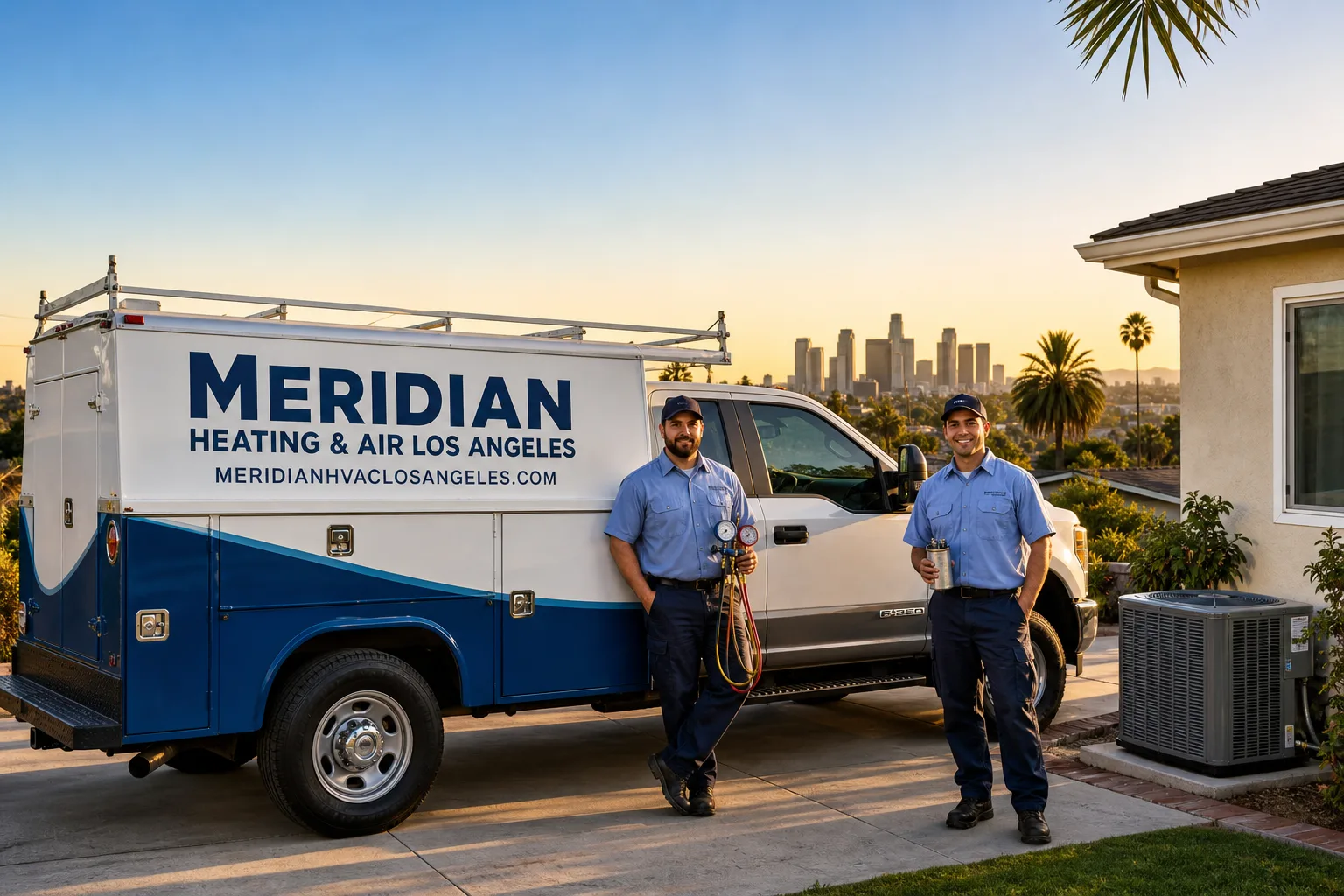
Fast, Reliable Emergency & Commercial HVAC Across Crestline
When your furnace quits at 5,000 feet in January, you don’t have time to wait for a valley contractor who doesn’t understand mountain heating loads. We respond to emergency HVAC calls throughout Crestline, from Lake Drive to the slopes above Valley of Enchantment, with trucks stocked for the specific failures this altitude and housing stock produce. Call (877) 454-5066 for emergency service or a free estimate on commercial or residential systems.
We’ve been climbing these mountain roads for nearly two decades. Anthony Moreno, our founder and lead installer, has personally handled furnace retrofits in Crestline’s converted vacation cabins where the original 1950s wood stove was the only heat source. That hands-on history matters when your system fails and the temperature’s dropping toward single digits.
Why Meridian Heating & Air Los Angeles Is Crestline’s Preferred Emergency & Commercial HVAC Company
Our reputation in Crestline was built one emergency call at a time. 286 customers have left verified reviews averaging 4.8 out of 5 stars, and a growing share of those come from mountain residents who initially called us after a valley company couldn’t solve their altitude-specific problem.
What changed their minds? We show up. Anthony Moreno still leads installations personally, not from an office in San Bernardino. When you book a service call in Crestline, you’re getting 19 years of continuous HVAC experience on your property, not whoever’s available from a rotating subcontractor pool.
Response time to Crestline runs longer than valley jobs simply because of the climb, but we prioritize true emergencies, especially no-heat calls during freeze warnings. We know which chains require tire chains, which routes stay open in snow, and which Crestline neighborhoods lose power first in winter storms. That local operational knowledge keeps us moving when less familiar crews get stuck.
We also understand the building stock. Crestline’s dominant housing type, 1940s-1970s wood-frame vacation cabins and A-frames on steep, wooded lots, presents retrofit challenges that valley HVAC companies rarely encounter: shallow crawl spaces, uninsulated subfloors, attics too tight for standard duct runs. We’ve routed ductwork through spaces that were never designed for it, and we know when a conventional central system makes sense versus a mini split or hybrid approach.
Our Emergency & Commercial HVAC Services in Crestline
24/7 Emergency HVAC
Heating failure at altitude isn’t uncomfortable. It’s dangerous. Crestline’s sustained winter subfreezing temperatures and regular snowfall make emergency furnace repair a life-safety service, not a convenience call. We answer emergency lines for Crestline residents and businesses through the night, with trucks stocked for the most common mountain failures: cracked heat exchangers on propane furnaces, frozen heat pump coils, and ignition system failures in high-altitude combustion air. We responded to a no-heat call on Lake Drive last January in a 1950s A-frame conversion. The original propane furnace was short-cycling on its high-limit switch because it was sized for sea-level load; we replaced it with a derated Carrier unit and sealed the crawl space, ending a pattern of cracked heat exchangers that had plagued the home every other winter.

Commercial HVAC
Crestline’s commercial base runs toward restaurants, small lodges, and retail along Lake Gregory Avenue and the highway corridor. These businesses face a unique challenge: heating loads driven by altitude and winter occupancy spikes, but cooling loads that remain modest compared to the Inland Empire valley. We size commercial systems for this skewed demand profile, not a generic inland California template. Our Emergency & Commercial HVAC team handles rooftop units, split systems, and zoned controls for properties from the village core to the steeper commercial pockets toward the lake.

Rooftop Unit Service
Commercial rooftops in Crestline take a beating that valley units don’t. Winter snow load, freeze-thaw cycling, and summer UV at elevation degrade components faster than manufacturers’ standard specs assume. We inspect and service RTUs with this accelerated wear in mind, checking heat exchanger integrity before heating season and refrigerant charge levels that altitude affects. For businesses on Lake Gregory Avenue or the highway commercial strip, we stock common RTU parts to minimize downtime when a unit fails during a busy winter weekend.

Chiller Service
While Crestline’s cooling demands are modest, certain commercial applications, server rooms, medical storage, and some hospitality setups, still need reliable chilled water or direct-expansion cooling. We service chillers and packaged cooling systems with attention to the reduced ambient design temperatures that mountain operation involves. Systems sized for valley summer peaks often short-cycle or fail to dehumidify properly in Crestline’s milder, drier summer conditions.

HVAC Inspection
Before you buy a converted cabin in Crestline, or before you commit to a major renovation, an HVAC inspection from a mountain-experienced contractor reveals problems that generalist inspectors miss. We check for valley-load furnace sizing, propane line capacity at altitude, ductwork routed through unconditioned spaces, and crawl space envelope deficiencies that will undermine any new system. The inspection report includes specific retrofit recommendations and realistic cost ranges.

Annual Maintenance
Crestline’s heating-dominant climate means your furnace or heat pump works harder than cooling equipment in most of California. Annual maintenance isn’t optional here; it’s how you avoid a 2 AM emergency call when the snow’s falling. Our tune-ups include combustion analysis on propane furnaces, defrost cycle verification on heat pumps, and inspection of outdoor units for freeze damage. We catch the cracked heat exchanger before it dumps carbon monoxide into a tight cabin envelope.

What happens when you call
- 1
A real person answersNo phone trees — you reach a local pro.
- 2
You get an upfront price rangeHonest numbers before anyone is dispatched.
- 3
A background-checked tech heads outLicensed & insured, dispatched right away.
- 4
You approve before work beginsNothing starts until you say go.
Trusted Brands We Service in Crestline
We work on your brand, not ours. Our experience covers Trane, Lennox, Goodman, and Rheem systems commonly found in Crestline’s retrofitted cabins and newer commercial installations. We stock parts for these brands in our service vehicles, which matters when a Friday night failure threatens a weekend without heat. Factory training on nine major manufacturers, including Carrier, York, Daikin, Bryant, and American Standard, means we’re not guessing when we diagnose your system. We’ve seen how each brand’s ignition controls, board logic, and defrost algorithms behave at 5,000 feet, and we adjust our troubleshooting accordingly.
Common Emergency & Commercial HVAC Problems We See in Crestline Homes
- Propane furnaces sized for valley loads short-cycle at altitude, cracking heat exchangers within two to three seasons. This is the most expensive failure we see in Crestline cabin conversions. A contractor who doesn’t derate for elevation installs a furnace that runs hot, cycles rapidly, and fails prematurely. The homeowner pays twice: once for the wrong unit, again for the replacement.
- Original wood-stove-only cabins lack any ductwork; adding central HVAC means routing through tight attics and uninsulated crawl spaces. Many Crestline homes were never designed for forced air. Retrofit ductwork in shallow crawl spaces loses heat to the ground, and attic runs in uninsulated A-frames bleed BTUs into spaces that hit freezing. Without simultaneous weatherization, even a properly sized system underperforms.
- Winter freeze-ups on outdoor heat pump units are frequent in Crestline’s sustained subfreezing temps. Vacation-home owners who don’t maintain defrost cycles return to find their heat pump encased in ice, compressor damaged, and auxiliary heat unable to carry the load. Annual maintenance prevents most of these failures.
- Low-density propane at 5,000 feet causes combustion problems in furnaces not adjusted for altitude. The same orifice that works in San Bernardino produces a lean, hot flame in Crestline that soots, wastes fuel, and overheats components. Proper derating and orifice sizing are basic steps that get skipped by contractors unfamiliar with mountain installation.
Pricing for Emergency & Commercial HVAC in Crestline, CA
Honest pricing starts with honest ranges. Here’s what typical Emergency & Commercial HVAC work costs in Crestline’s market:
| Service | Typical Range in Crestline |
|---|---|
| Furnace Repair | $150–$700 |
| AC Installation | $3,500–$7,500 |
| Tune-Up | $80–$200 |
What moves you within these ranges? Accessibility matters in Crestline. Steep driveways, snow-covered roofs, and crawl spaces too tight for standard equipment add labor time. The condition of existing infrastructure matters too: a furnace swap in a cabin with proper ductwork and gas lines runs toward the lower end; a full retrofit with new propane routing, duct fabrication, and envelope sealing runs higher. Emergency calls outside standard hours carry additional trip charges, but we quote upfront before any work begins. Call (877) 454-5066 for a free estimate with exact numbers for your situation.
We Also Serve Cities Near Crestline
Our mountain service area extends to Lake Arrowhead for similar cabin-retrofit and altitude-specific work, Muscoy for valley-to-foothill transitions, and San Bernardino and Highland for commercial and residential systems at lower elevations. Each location gets the same owner-led service, with load calculations and equipment selections matched to local conditions.
Serving Crestline, CA — Our Local Coverage Area
We’re based in the Crestline area and know this community well. Use the map below to see our service coverage — if you’re nearby, we can almost certainly help.
FAQs — Emergency & Commercial HVAC in Crestline
Propane furnaces fail more frequently in Crestline because most are sized using sea-level or valley load calculations that ignore altitude’s effect on combustion air density and heating demand. At 4,700–5,000 feet, the thinner air produces leaner combustion, reduced heat transfer efficiency, and higher stack temperatures that stress heat exchangers. Contractors unfamiliar with mountain installation skip the derating step, and the furnace short-cycles itself to failure within two or three heating seasons. Call (877) 454-5066 if your propane furnace is cycling rapidly or producing soot, we can inspect the heat exchanger before it cracks.
Yes, but central AC in a ductless cabin requires careful evaluation of whether conventional ductwork is feasible or whether a ductless mini split system makes more sense. Many Crestline A-frames and cabins have attics too shallow for standard duct runs and crawl spaces too tight to route supply lines without major structural modification. We’ve installed both approaches: custom low-profile duct systems in cabins where the owner wanted central air, and multi-zone mini splits where routing was impractical. The right choice depends on your floor plan, insulation status, and budget. Call (877) 454-5066 for an on-site assessment and honest recommendation.
Yes, we maintain emergency availability for Crestline through winter weather, though response times extend when chain controls are active on mountain roads. We prioritize no-heat calls as life-safety emergencies, especially for homes with vulnerable occupants. Our trucks carry tire chains, and we monitor Caltrans road conditions to route around closures. If you’re without heat during a storm, call (877) 454-5066 immediately; we’ll give you a realistic ETA and interim safety guidance while we’re en route.
In Crestline’s converted cabin stock, a weatherization assessment is strongly recommended before any major HVAC replacement. The dominant housing type, 1940s-1970s wood-frame vacation cabins with uninsulated subfloors and tight attics, has envelope deficiencies that will undersize even a correctly calculated heating system. We’ve seen too many new furnaces installed in leaky cabins that still can’t maintain temperature because the heat escapes faster than the system produces it. Our inspections evaluate insulation, air sealing, and ductwork location; sometimes the best investment isn’t a bigger furnace but sealing the crawl space and adding attic insulation. Call (877) 454-5066 to schedule a combined HVAC and weatherization assessment.
Once yearly, ideally in early fall before the first sustained freeze. Crestline’s heating-dominant climate means furnaces and heat pumps accumulate more runtime hours than valley equivalents, and the altitude stress on combustion components accelerates wear. Our tune-ups include propane pressure verification, heat exchanger inspection for crack propagation, defrost cycle testing on heat pumps, and outdoor coil cleaning before ice season. Annual maintenance catches the problems that become emergency failures in January. Call (877) 454-5066 to schedule your fall tune-up, we book Crestline appointments to minimize your wait through the heating season.
Written by Anthony Moreno, Owner at Meridian Heating & Air, serving Crestline and the San Bernardino Mountains since 2005.