
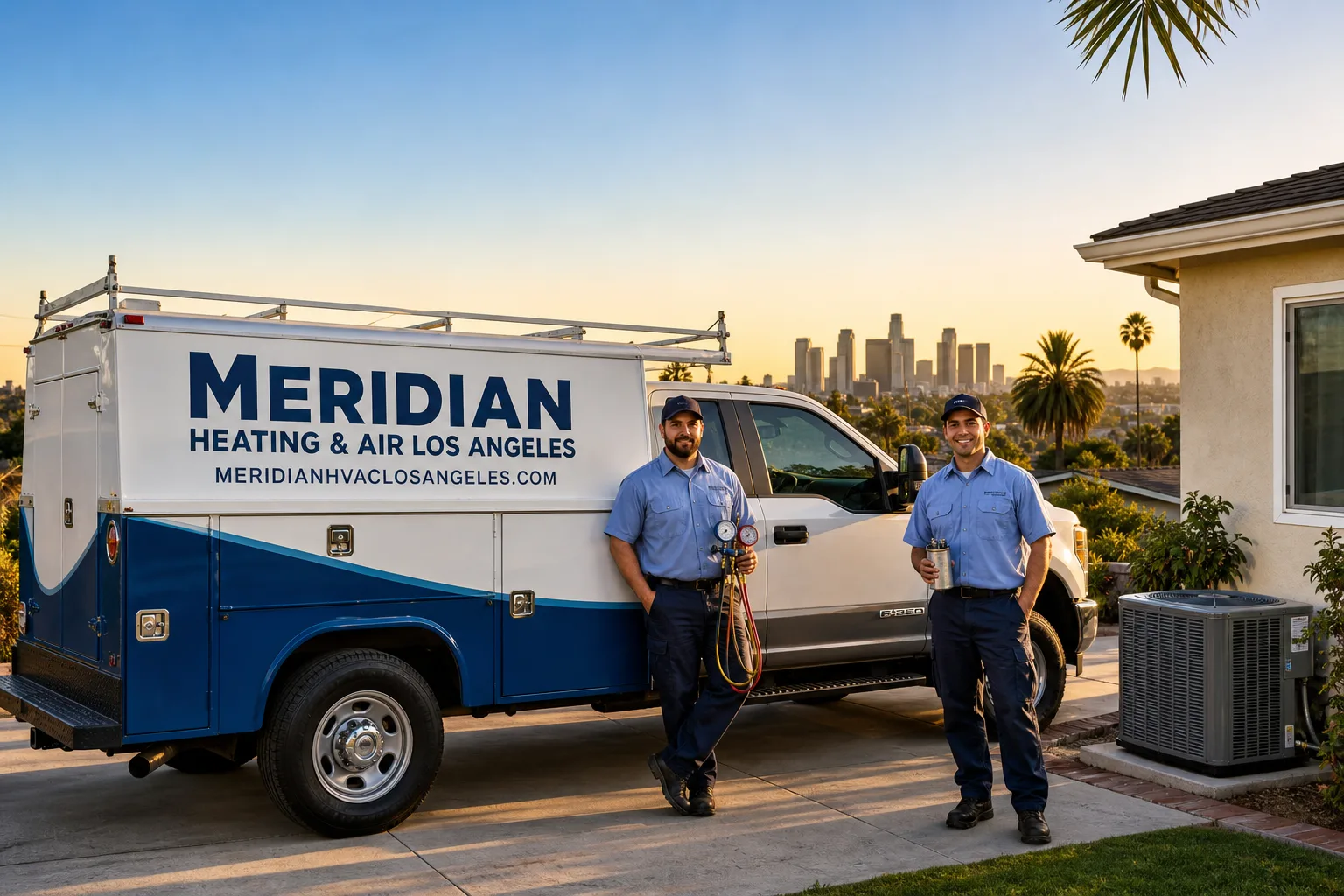
Fast, Reliable Heating & Furnace Across Glendora
When your furnace quits on a January night in Glendora, you don’t have time to wait around. We answer calls from homeowners in 91740 and 91741 with same-day service, and Anthony Moreno, our founder and lead installer, still shows up on the job himself — nearly two decades of hands-on HVAC experience behind him. Call (877) 454-5066 for a free estimate on furnace repair, replacement, or tune-up anywhere in Glendora, from the flat southern neighborhoods near Foothill Boulevard to the hillside tracts below the San Gabriel Mountains.
Why Meridian Heating & Air Los Angeles Is Glendora’s Preferred Heating & Furnace Company
We’ve been serving the San Gabriel Valley long enough to know Glendora’s housing stock inside and out. The bulk of homes here went up during the 1950s–1970s tract-home boom — slab-on-grade and raised-foundation single-stories with ductwork baking in attic cavities that hit 150°F on peak summer days. That specific thermal stress pattern cracks heat exchangers and degrades duct seals faster than in cooler coastal zones. Anthony Moreno has replaced dozens of furnaces in Glendora alone, and he brings that accumulated field knowledge to every service call.
Our 286 verified reviews average 4.8 out of 5 stars, and many come from repeat customers in Glendora and nearby cities who’ve learned that an owner-operated company means consistent expertise, not a rotating crew of subcontractors. When you call Meridian, Anthony shows up on the job — the same person who sized the system, diagnosed the failure, and stands behind the repair.
We’re also familiar with the split reality of Glendora’s climate. The southern flatlands in 91740 sit in a natural heat trap where summer temperatures run 10–15°F above coastal LA, while the northern hillside homes in 91741 lie inside Wildland-Urban Interface fire hazard zones. That dual environment means we regularly sell and service both maximum heating efficiency and whole-house air filtration in the same market — something flat-valley contractors simply don’t encounter.
Our Heating & Furnace Services in Glendora
Furnace Repair
A typical furnace repair in Glendora runs $175–$825, depending on the part and accessibility. We see the most calls from south Glendora’s older tract homes where original furnaces from the 1960s and 1970s finally give out — often with cracked heat exchangers from decades of thermal cycling in superheated attics. We work on your brand, whether it’s a legacy Carrier, a Rheem, a York, or a Daikin system, and we stock common parts to avoid delays.

Furnace Replacement
When the heat exchanger is cracked or repair costs approach half the value of a new system, replacement makes sense. In Glendora, a full furnace replacement typically costs $3,500–$7,500 installed. We replaced a 1970s-era Carrier furnace on a slab-home near the intersection of Foothill Boulevard and Sunflower Avenue in 91740; the original heat exchanger had cracked due to thermal stress from attic temperatures exceeding 150°F, and the homeowner opted for a new Trane modulating furnace with MERV-13 filtration to address both heating efficiency and smoke concerns. Anthony personally sizes every replacement for the actual load — not a rule-of-thumb square-footage guess.

Furnace Tune-Up
Our Heating & Furnace tune-ups in Glendora cost $95–$235 and include combustion analysis, gas pressure verification, heat exchanger inspection, and filter assessment. In Glendora’s climate, we recommend annual tune-ups before the heating season — the low humidity and extreme temperature swings stress components differently than in coastal markets. In the hillside neighborhoods of north Glendora directly below the 2014 Colby Fire burn scar, technicians regularly field requests to upgrade existing systems to MERV-13 or HEPA-bypass filtration during what starts as a routine tune-up call. Homeowners here have a visceral, post-fire awareness of smoke infiltration that translates directly into upsell acceptance rates noticeably higher than in neighboring flat-valley communities.

Heat Exchanger Inspection & Replacement
Heat exchanger cracks are the most serious failure we find in Glendora’s older housing stock. The 1950s–1970s slab homes with attic ductwork are especially prone — decades of thermal expansion and contraction in 150°F attic cavities fatigue the metal until it fails. A cracked heat exchanger can leak carbon monoxide into your living space. We use combustion analyzers and visual inspection protocols to verify integrity, and if replacement is needed, we’ll show you exactly what we found before recommending repair versus full system replacement.

What happens when you call
- 1
A real person answersNo phone trees — you reach a local pro.
- 2
You get an upfront price rangeHonest numbers before anyone is dispatched.
- 3
A background-checked tech heads outLicensed & insured, dispatched right away.
- 4
You approve before work beginsNothing starts until you say go.
Trusted Brands We Service in Glendora
We work on your brand — not just the ones we prefer to sell. Anthony is factory-trained or field-experienced on nine major HVAC brands: Carrier, Trane, Lennox, Goodman, Rheem, York, Daikin, Bryant, and American Standard. For Glendora customers, that means faster repairs because we don’t have to special-order basic parts for common systems. Whether you’ve got a 25-year-old Bryant in Charter Oak or a newer Daikin mini split in north Glendora, we can service it properly without upselling you into a complete replacement unless it’s truly warranted.
Common Heating & Furnace Problems We See in Glendora Homes
- Heat exchanger cracks in 1950s–1970s slab homes. Attic temperatures exceeding 150°F on peak summer days accelerate thermal fatigue. We find hairline fractures during fall tune-ups that homeowners never suspected — the kind of hidden failure that makes professional inspection non-negotiable in this housing stock.
- Ignitor and gas valve failures in hillside homes (91741). Steep lots require longer electrical and gas line runs, which create voltage drop and pressure fluctuation issues. The ignition systems in modern high-efficiency furnaces are particularly sensitive to these conditions.
- Duct seal failures in raised-foundation homes. Unconditioned crawl spaces in Glendora’s older stock accelerate corrosion of metal ductwork and degradation of flex duct connections. A furnace can be working perfectly while half the heat leaks into the crawl space.
- Smoke infiltration damage to filtration and coil systems. The Santa Ana and Diablo wind events funnel wildfire smoke down-canyon from the San Gabriel Mountains, loading standard 1-inch filters beyond capacity and forcing blower motors to work harder. North Glendora homeowners below the burn scar feel this most acutely.
Pricing for Heating & Furnace in Glendora, CA
Here’s what furnace service actually costs in Glendora’s market:
| Service | Typical Range in Glendora |
|---|---|
| Furnace Repair | $175–$825 |
| Furnace Replacement | $3,500–$7,500 |
| Furnace Tune-Up | $95–$235 |
Actual cost depends on system accessibility, parts availability for your specific brand and model, and whether code upgrades are required. Older Glendora homes often need flue modifications or electrical updates when replacing legacy furnaces. We provide upfront pricing before any work begins — call (877) 454-5066 for a free estimate with no pressure to commit.
We Also Serve Cities Near Glendora
Our service radius covers the full San Gabriel Valley foothill corridor. We regularly run calls to San Dimas, Azusa, Citrus, and Charter Oak — often the same day when the schedule allows. The same owner-led expertise applies whether we’re working on a hillside home in Glendora or a commercial system in downtown Azusa.
Serving Glendora, CA — Our Local Coverage Area
We’re based in the Glendora area and know this community well. Use the map below to see our service coverage — if you’re nearby, we can almost certainly help.
FAQs — Heating & Furnace in Glendora
Yes — if you live below the Colby Fire burn scar, MERV-13 or HEPA-bypass filtration is a practical upgrade that many of your neighbors have already made. The 2014 fire created lasting awareness of smoke infiltration in this specific zone, and standard 1-inch filters don’t capture the fine particulate that wildfire events push down-canyon. During your next tune-up, ask us to assess whether your blower motor and duct system can handle the increased static pressure of MERV-13 without modification. Call (877) 454-5066 to schedule — estimates are free.
A new furnace will work, but the ductwork is often the weak link. Attic cavities in south Glendora’s slab homes regularly hit 150°F, and original metal duct from the 1960s has likely developed leaks, corrosion, and insulation degradation. We always pressure-test existing ductwork before quoting a replacement, because installing a high-efficiency furnace on leaky ducts wastes money and comfort. In many cases, partial duct sealing or replacement in the attic pays for itself faster than the furnace upgrade alone.
Once yearly, ideally in early fall before the first cold nights. Glendora’s extreme temperature range — summer attic heat over 150°F followed by winter heating demand — creates more thermal cycling stress than coastal climates. Annual combustion analysis, heat exchanger inspection, and gas pressure verification catch the failures that Glendora’s specific conditions accelerate. 286 customers and counting have kept their systems running longer with this schedule.
Long electrical runs on steep lots create voltage drop that strains hot-surface ignitors, which are designed to operate within a narrow voltage window. The hillside homes in 91741 are particularly susceptible because the furnace is often farthest from the main electrical panel, and the ignitor cycles hundreds of times per heating season. We measure actual voltage at the furnace during startup, not just at the panel — and if the drop exceeds manufacturer spec, we’ll recommend a wiring upgrade rather than replacing ignitors every other winter.
Replacement is usually the smarter investment once repair costs exceed $600–$800 on a furnace over 20 years old. A 1970s unit in Glendora is likely operating at 60–70% efficiency versus 80–98% for modern equipment, and the original heat exchanger is at elevated risk of cracking from decades of thermal stress. That said, if the system is a simple pilot-ignition model with a failed gas valve and the heat exchanger tests clean, a targeted repair can buy a few more seasons. Anthony will show you the combustion analysis and heat exchanger photos so you can decide with real information, not sales pressure. Call (877) 454-5066 for an honest assessment — estimates are free.
Written by Anthony Moreno, Owner at Meridian Heating & Air Los Angeles, serving Glendora and the San Gabriel Valley since 2005.