
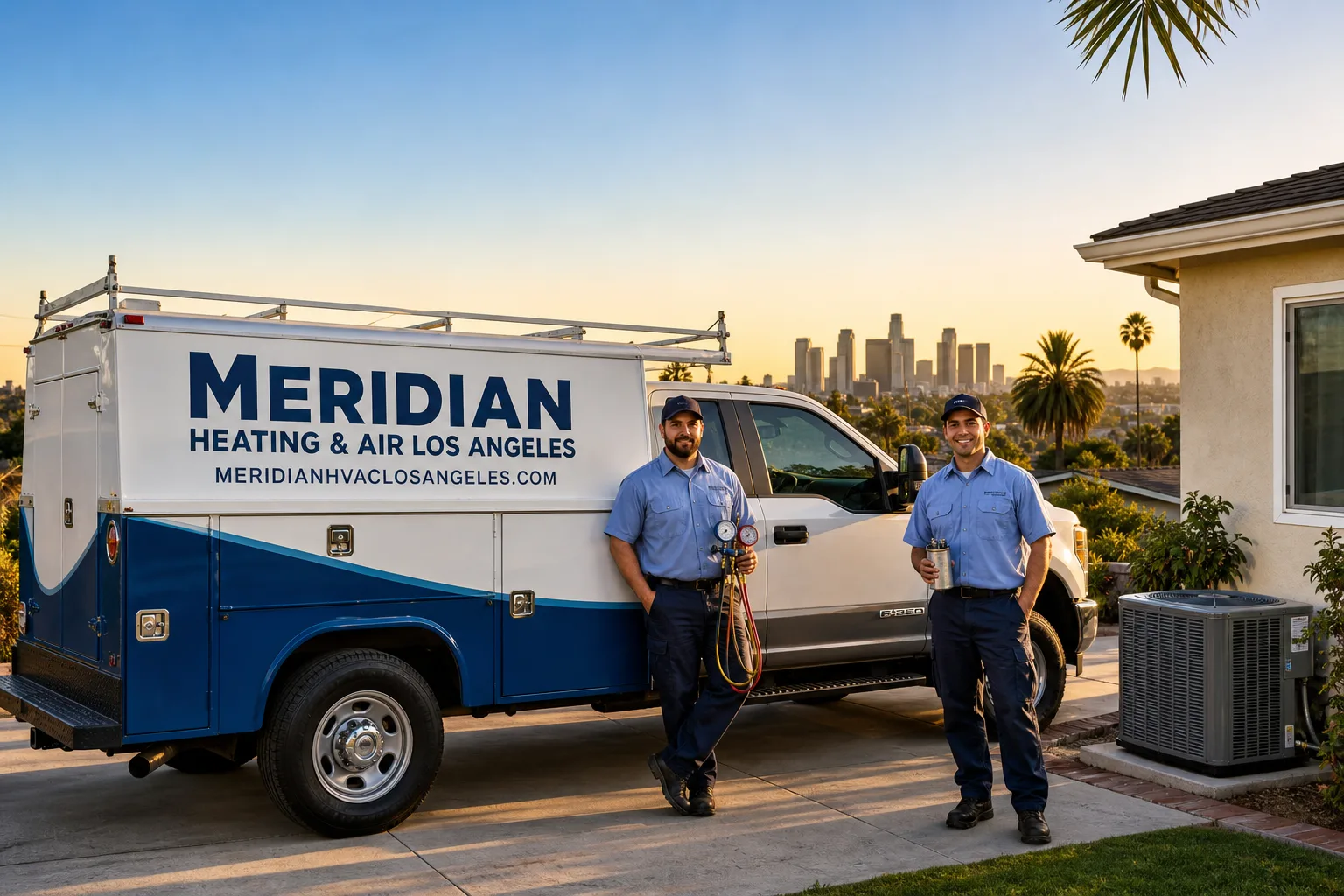
Fast, Reliable Heating & Furnace Across South San Jose Hills
When your furnace quits on a January night in South San Jose Hills, you don’t have time to wait around. We’re Meridian Heating & Air Los Angeles, and we answer calls from the 91792 ZIP and surrounding hillside neighborhoods directly, with Anthony Moreno usually on the truck that shows up. Most South San Jose Hills residents get same-day or next-day service because we’re already working the inland San Gabriel Valley corridor between Valinda, Walnut, and Rowland Heights. Call (877) 454-5066 for a free estimate or to schedule a repair.
We’ve been up and down the sloped streets here for nearly two decades, from the split-levels on Pathfinder Road to the hillside tracts backing against the Puente Hills. That local familiarity matters. We know which homes still run original 1970s Lennox and Carrier furnaces with standing pilot lights, which crawl spaces flood with winter runoff, and how Santa Ana wind dust works its way into burner assemblies. You get that knowledge on every call because Anthony, our founder, still leads the installs and repairs himself.
Why Meridian Heating & Air Los Angeles Is South San Jose Hills’s Preferred Heating & Furnace Company
Our reputation in South San Jose Hills was built one hillside service call at a time. We’ve got 286 verified reviews averaging 4.8 out of 5 stars, and a significant share of those come from repeat customers in the eastern San Gabriel Valley who’ve watched us solve problems that other companies misdiagnosed or walked away from.
Response time to South San Jose Hills is typically same-day for non-emergency calls and prioritized for heat-out situations, especially during cold snaps when older furnaces across the 91792 ZIP fail in clusters. We’re not routing you through a call center in another state or sending a subcontractor who’s never seen a hillside flue chase. Anthony shows up on the job, assesses the actual conditions, and explains what your specific home needs.
That local expertise translates to faster fixes and fewer return trips. We know, for instance, that a “furnace failure” on a 1970s split-level near Red Maple Drive is often a duct-design problem masquerading as equipment failure, or that a standing-pilot lockout in January usually traces back to Santa Ana dust coating the thermocouple. We don’t guess. We know these houses because we’ve worked on them for 19 years.
Our Heating & Furnace Services in South San Jose Hills
Furnace Repair
A typical furnace repair in South San Jose Hills runs $175–$825, depending on whether we’re cleaning a dust-fouled pilot assembly or replacing a failed gas valve corroded from hillside crawl-space moisture. The 1965–1985 tract homes here present specific challenges: original ribbon burners and standing-pilot controls are often discontinued, so we stock compatible aftermarket parts and maintain relationships with regional suppliers for obsolete Lennox, Carrier, and Rheem components. If your furnace keeps cycling on and off or won’t stay lit, we’ll diagnose whether it’s a flame-sense issue, a cracked heat exchanger, or the more common problem of undersized ductwork causing limit-switch trips.

Furnace Replacement
Replacing a furnace in South San Jose Hills is rarely a simple swap. The hillside framing in these homes often contains flue chases too small for modern high-efficiency condensing furnaces, which require PVC venting rather than traditional metal chimneys. On a 1978 split-level on Red Maple Drive, we found the furnace heat exchanger had cracked from thermal stress after a Santa Ana wind event pushed the home’s temperature differential to extremes. The original Lennox G8 furnace could not be repaired because the burners and controls were discontinued; we replaced it with a 96% AFUE Carrier modulating unit, which required rerouting a new PVC intake through the hillside foundation—a common retrofit here. We handle these conversions regularly, and we’ll tell you upfront if your home needs flue relining, power-vent conversion, or duct resizing alongside the new unit.

Furnace Tune-Up
A furnace tune-up in South San Jose Hills costs $95–$235 and pays for itself in efficiency gains alone, especially on original or first-replacement units still running at 70–80% AFUE. Our tune-ups include burner cleaning, thermocouple testing, gas-pressure verification, and heat-exchanger inspection for cracks or rust-through. Given the Santa Ana wind dust that settles in these hillside neighborhoods every fall, we pay particular attention to flame-sensor degradation and filter loading. We recommend annual service in October, before the first cold snap sends every 1970s furnace in the 91792 ZIP into simultaneous overtime.

Heat Exchanger Inspection & Replacement
Heat exchanger failure is a safety issue we take seriously, and it’s more common in South San Jose Hills than many homeowners realize. Hillside crawl spaces trap moisture and debris, causing rust-through on exchanger panels in furnaces more than 20 years old. A cracked exchanger can leak carbon monoxide into your living space. We inspect with visual, chemical, and combustion-analysis methods, and we’ll show you exactly what we find. Replacement sometimes makes sense on a 15-year-old unit; other times, the discontinued parts and cumulative corrosion mean a full furnace replacement is the smarter investment. We’ll give you both options with real numbers.

Gas Valve Repair
Gas valve failure in South San Jose Hills often traces to corrosion from damp hillside crawl spaces or debris infiltration from unsealed return plenums. Symptoms include delayed ignition, erratic flame patterns, or complete failure to open. We carry replacement valves for Goodman, Rheem, Trane, and Lennox systems common to this area, and we test manifold pressure to factory spec after every installation. Because gas valve work involves live fuel lines, this is not a DIY repair; we recommend a trained professional for any fuel-gas component service.

What happens when you call
- 1
A real person answersNo phone trees — you reach a local pro.
- 2
You get an upfront price rangeHonest numbers before anyone is dispatched.
- 3
A background-checked tech heads outLicensed & insured, dispatched right away.
- 4
You approve before work beginsNothing starts until you say go.
Trusted Brands We Service in South San Jose Hills
We work on your brand, not just the ones we prefer to sell. Our technicians are factory-trained or field-experienced on Carrier, Trane, Lennox, Goodman, Rheem, York, Daikin, Bryant, and American Standard, which covers the vast majority of furnaces installed in South San Jose Hills’s 1965–1985 housing stock. We stock common Lennox and Carrier ignition modules, Rheem gas valves, and Goodman heat exchangers at our Los Angeles warehouse, so most repairs don’t wait on parts orders. For discontinued components on original 1970s units, we source compatible aftermarket parts or engineer retrofit solutions rather than pushing premature replacement.
Common Heating & Furnace Problems We See in South San Jose Hills Homes
- Standing-pilot lockouts from Santa Ana dust. Original 1970s furnaces with standing pilots suffer flame-sense failures when fine dust from Santa Ana winds coats the thermocouple, leading to intermittent lockouts that clear temporarily but return with the next wind event. Cleaning helps; upgrading to electronic ignition eliminates the problem.
- Floor-to-floor temperature swings in split-level homes. Undersized ductwork in split-level homes causes severe floor-to-floor temperature swings during heating season, often misdiagnosed as furnace failure when it’s actually a zoning and duct-design problem specific to the hillside stock here.
- Heat exchanger rust-through from crawl-space moisture. Hillside crawl spaces trap moisture and debris, causing rust-through on heat exchanger panels and gas valve corrosion in furnaces more than 20 years old. We catch this during tune-ups before it becomes a carbon monoxide hazard.
- Flue-drafting problems in converted high-efficiency installs. Homeowners who replaced furnaces without addressing undersized flue chases sometimes get backdrafting or condensation damage in the chimney. We inspect the full venting system, not just the appliance.
Pricing for Heating & Furnace in South San Jose Hills, CA
We’re straightforward about what things cost because nobody likes surprise invoices. Here’s what South San Jose Hills homeowners typically pay:
| Service | Price Range |
|---|---|
| Furnace Repair | $175 – $825 |
| Furnace Tune-Up | $95 – $235 |
Replacement pricing depends on whether your hillside home needs flue modification, duct resizing, or zoning additions alongside the new furnace. A basic 80% AFUE replacement in a flat-valley city might run lower, but South San Jose Hills’s sloped lots and framing constraints often add $800–$2,500 for venting and ductwork corrections. We itemize everything in your free estimate so you know exactly what’s driving the total. Call (877) 454-5066 to schedule yours.
We Also Serve Cities Near South San Jose Hills
Our service area covers the full eastern San Gabriel Valley corridor. We regularly answer calls from Valinda just to the west, Walnut and West Covina to the south, and Rowland Heights to the southeast. If you’re in any of these communities and need Heating & Furnace service from a company that knows the inland valley’s older housing stock, we’re already in your neighborhood.
Serving South San Jose Hills, CA — Our Local Coverage Area
We’re based in the South San Jose Hills area and know this community well. Use the map below to see our service coverage — if you’re nearby, we can almost certainly help.
FAQs — Heating & Furnace in South San Jose Hills
Yes, that’s the most common cause of intermittent lockouts in original standing-pilot furnaces here. Santa Ana winds push fine dust through attic vents and crawl-space gaps, coating the thermocouple and weakening the flame signal. We clean and adjust the pilot assembly during a standard service call, and if the problem recurs, we usually recommend upgrading to electronic ignition. Call (877) 454-5066 for an exact quote—estimates are free.
You can, but you probably shouldn’t. The original ductwork in these hillside split-levels was sized for the furnace that was installed in 1968, and it’s almost always undersized for modern airflow requirements. Putting a new high-efficiency unit on old ducts creates static pressure problems, reduced efficiency, and the same hot-upstairs/cold-downstairs complaints you likely already have. We assess duct capacity as part of every replacement estimate and show you the performance difference with and without upgrades.
This is a duct-design and zoning problem, not a furnace failure. On hillside homes along the steeper streets backing up to the Puente Hills, technicians routinely find that original 1970s-era duct runs were undersized for the slope-induced heat stratification. The furnace is producing heat; it’s just not getting distributed evenly. We solve this with duct modifications, zone dampers, or in some cases a supplemental mini-split for the upper level.
Usually not. By 2025, that furnace is 40 years old, and the heat exchanger is only one of several components near end of life. The gas valve, blower motor, and controls are all original-era or first-replacement parts with limited remaining service life. We can source aftermarket exchangers for some Trane models, but we typically recommend full replacement when the unit exceeds 20 years, especially given the efficiency gains of modern 96% AFUE systems. We’ll give you both quotes and let you decide.
We install Carrier, Trane, Lennox, Goodman, and Rheem furnaces in South San Jose Hills, and the “best” brand depends on your specific home. For hillside homes with flue-chase constraints, we often favor Carrier or Trane modulating units with flexible venting options. For budget-conscious replacements where ductwork is adequate, Goodman and Rheem offer strong value. Anthony will assess your home’s venting, duct capacity, and heating load before recommending a specific model. Call (877) 454-5066 to schedule that assessment.
Written by Anthony Moreno, Owner at Meridian Heating & Air Los Angeles, serving South San Jose Hills and the San Gabriel Valley since 2006.